Category: Uncategorized

  • SAT vs ACT: Which One Should You Take?

    SAT vs ACT: Which One Should You Take?

    SAT or ACT?

    Parents and students start the college process by comparing the SAT and ACT tests. The SAT and ACT cover generally the same topics, and both scores are used for college admissions decisions and the awarding of merit based scholarships.

    In the past, schools on the coasts generally gravitated towards the SAT while those in the midwest preferred the ACT. Now, however, the college application landscape has changed and schools have become increasingly flexible; both tests are now widely accepted across all US colleges.

    Don’t let the question of SAT or ACT keep you up at night! Know the basics about each test, your strengths and weaknesses as a test taker, and focus on!

    Comparing the SAT and ACT:

    ACT includes a Science section, the SAT does not.

    SAT includes one SAT Math Section where you may not use a calculator.

    Aspect SAT ACT
    Why Take It Colleges use SAT scores for admissions and merit-based scholarships. Colleges use ACT scores for admissions and merit-based scholarships.
    Test Structure Reading, Writing & Language, Math, Essay (Optional) English, Math, Reading, Science Reasoning, Essay (Optional)
    Length 3 hours (without essay) / 3 hours, 50 minutes (with essay) 2 hours, 55 minutes (without essay) / 3 hours, 40 minutes (with essay)
    Reading 5 reading passages 4 reading passages
    Science None 1 science section testing your critical thinking skills (not your specific science knowledge)
    Math Arithmetic, Algebra I & II, Geometry, Trigonometry and Data Analysis Arithmetic, Algebra I & II, Geometry, Trigonometry, and Probability & Statistics
    Calculator Policy Some math questions don’t allow you to use a calculator. You can use a calculator on all math questions.
    Essays Optional. The essay will test your comprehension of a source text. Optional. The essay will test how well you evaluate and analyze complex issues.
    How It’s Scored Scored on a scale of 400–1600 Scored on a scale of 1–36

    from the Princeton Review

    Here’s an interesting analogy comparing the two tests:

    The ACT is like lifting a 5 pound weight ten times while the SAT feels like lifting 25 pound weights twice. Both are quite draining, but in different ways. The ACT is extremely fast paced while the SAT requires you to think more and deeply.

    Important note: Be sure to look carefully at admission preferences and requirements to double check which of the tests your prospective college accepts.

    According to the College Board, while both tests measure what you learned in high school, the SAT is a better indicator of skills you will actually need to succeed in college and beyond. Instead of focusing on how well you can recall information, the SAT emphasizes one’s ability to apply it in real world scenarios. This is why the SAT provides everyday math formulas while the ACT expects you to memorize them.

    Test Format

    Structure and Timing SAT ACT
    Testing time 3 hours + 50 minute essay (optional) 2 hours 55 minutes + 40 minute essay (optional)
    Structure 3 tests + optional essay 4 tests + optional writing test
    Number of questions 154 215
    Number of breaks 3 2
    Time per question 1 minute, 10 seconds 49 seconds
    Score range Composite 400–1600 (SAT Essay: reported in 3 dimensions, each 2–8) Composite 1–36 (writing domain scores: 2–12)
    Test length and timing Reading Test: 65 minutes, 52 questions. Writing and Language Test: 35 minutes, 44 questions. Math Test: 80 minutes, 58 questions Reading Test: 35 minutes, 40 questions. English Test: 45 minutes, 75 questions. Math Test: 60 minutes, 60 questions. Science Test: 35 minutes, 40 questions

    from the College Board

    Test Timing

    With the SAT having a total of 154 multiple choice questions and the ACT having 215, timing is one of the most important aspects to consider when deciding between which test to take. Based on individual time windows, you have around 1 minute and 10 seconds per question on the SAT and 49 seconds per question on the ACT.

    A little bit stressed out?

    I feel you. Test taking is honestly one of the worst things about the college process in my experience. We love spending summertime huddled over practice tests and test prep books and watching everybody else have fun. Are you feeling this FOMO? Do you find yourself “reading” through grammar rules only to realize that you’ve actually just been looking at the words and not processing anything? It happens to the best of us. Want to crush the ACT or SAT in the next few weeks? We got you. Prepmedians teaches ACT and SAT test prep through entertaining and engaging ways with sketch comedy, music, rap, and more. We’ll get you through those boring summer study days in no time. Check us out today!

  • The Night Before the ACT/SAT

    The Night Before the ACT/SAT

    Review your toughest subject

    Choose the section that you have struggled the most with throughout the test prep process and do a quick review. It could be anything from reviewing a math concept you have struggled with, glancing over grammar rules or looking over a reading passage. Whatever the quick review is, the purpose is not to teach you a brand-new concept, but rather for you to know that you have done everything you could to prepare for the test and to walk into your test the next day feeling confident.

    Eat a good dinner

    Don’t forget to eat a tasty and filling meal the night before for dinner! Maybe your favorite meal (because is there anything else that makes someone feel good before a big day?) But avoid eating anything that is too greasy to make sure you don’t end up with an upset stomach. The last thing you need is your stomach rumbling during the math section because of those chili cheese fries. For more suggestions on what kind of meal is more ideal, refer to Is your Brain Hungry by Gerrin Alexander. Try to eat at a reasonable time, so the dinner does not interfere with your sleep. Keeping your body in good condition is a vital part of being prepared for anything—including test day!

    Pack your test materials

    Checklist for the test day:
    – admission ticket to the test
    – a photo ID (check the test website for what forms of ID are acceptable—generally, a valid driver’s license or a current school ID will be fine)
    – at least two #2 pencils
    – test acceptable calculator (check the test website to know what types are acceptable)
    The night before the test day, be sure to pack all the test materials that you need for the test day. You may also want to pack a healthy snack and bottled drink for the break, to keep your energy for the second half of the test. When choosing a snack, avoid anything too sweet or too salty because it will make you thirsty during the test. A healthy suggestion would be granola bars of some kind to provide you with energy since they are high in protein. Packing all the materials you need for the test the night before would save you the panic of finding everything you need moments before the test!

    Time to relax

    After packing the necessary things, don’t forget to spend some time relaxing. It can be anything from watching a favorite movie, listening to music, unwinding with a video game, or even just spending time with someone. You should probably try not to do anything physically taxing like sports because you don’t want to tire yourself out. Make sure you’re spending your evening doing something you enjoy. The important thing is to feel happy and relaxed. You’ve worked hard preparing for the test, and your mind and body need time to “recharge” before the test. While a good night’s sleep can restore your energy, free time doing something not only restful, but that makes you happy, is important to get you into the right mindset the day before the test.

    We recommend going through our 3.5 minute positive psychology exercise, which you can listen to here. This exercise will help you visualize the testing situation so that you can destress before you even get to the room.

    Get a good night’s sleep

    I am sure you have gotten this advice in all forms before. But what can you do? It is true. Scientific studies have shown how important a good night’s sleep is for improved brain functioning. Using your mind burns more calories than any form of exercise, so taking the test will have the same effect on your energy as spending the morning doing intense workouts. No wonder you need a good night’s sleep! Keep an alarm before going to sleep because the test would be early in the morning and you need to be at the testing center on time. Try to get at least eight hours of sleep, that’s the minimum recommended for adolescents, although nine or ten hours are fine as well. This might mean going to sleep earlier than you usually do, especially for a Friday night, but being well rested on test day is more than worth it!

    The morning of…

    The morning of the test, be sure to get up with enough time to eat some breakfast and get to the testing site with at least fifteen minutes to spare. A good night’s preparation, relaxation, and rest should have you feeling calm and confident for the test itself—you’ve got this!

  • Common Myths About ACT/SAT

    Common Myths About ACT/SAT

    Myth 1:

    The SAT is more accepted among colleges than ACT.

    NO! A common myth is that top-tier schools tend to prefer SAT over ACT. But in reality, all schools accept and look at ACT and SAT in the same scale. The preference of students to take SAT or ACT tends to rely on students’ resident states. The ACT is more popular in the Midwest than the SAT, considering many states in the Midwest require mandatory ACT testing. Students from the West or the East coast tend to prefer the SAT over the ACT. So, the difference in proportion of ACT and SAT scores among the accepted pool in top-tier schools is caused more by the personal preference of students rather than by the preference of colleges.

    Myth 2:

    The October and December ACT/SATs are harder because more seniors tend to take them last minute.

    NO! There were comparative studies done about the average scores from one testing month to another and October had a lower average than May. Thus, the rumors about easier testing dates started running wild. But these testing dates keep changing. Sometimes it’s December with the lowest average and sometimes it’s June. Any student might find one test slightly easier than the other. One section or even one question could seem easier. But that opinion is different for every student. So, don’t pick a date based on this myth. Instead, pick a date that best works with your schedule.

    Myth 3:

    ACT is only for people who have a good science background.

    NO! The ACT Science section tests your ability to read and analyze passages, charts, tables, and graphs. It is not trying to test your in-depth knowledge and understanding of all areas of science. While it does present passages and experiments of science fields like biology, chemistry and others, it is your reasoning and reading comprehension skills that will actually help you in this section (not your hard science knowledge!).
    P.S. The SAT tests your ability to analyze data and graphs too. It does so in a more hidden way by mixing it with other sections.

    Myth 4:

    The ACT is “easier” than the SAT.

    NO! The ACT is not necessarily easier, it’s just that the questions tend to be more straightforward. Students who take the SAT and the ACT with an equal amount of preparation for both tend to score equivalently on both. The SAT has a no-calculator section unlike the ACT. Most students, however, realize that the calculator is not really necessary even for the SAT section that does allow it. It is worth exploring both tests to see which one is better for you! You can prepare for both at Prepmedians.

    Myth 5:

    You have to spend a lot of money to do well on the ACT/SAT.

    NO! Sure, there are many test prep courses require you to spend a lot of money, sometimes even many thousands of dollars. And the cost is often positively correlated with the amount of time you spend. But it’s important to note that the ACT/SAT tests your knowledge gained from all your K-12 education. Most of the topics these tests focus on, like algebra, tend to be from earlier stages of schooling than later. So, none of the topics tested by ACT/SAT are completely new. Rather, they try to gauge how well you understand the fundamental topics. It is not worth paying someone thousands of dollars to have them reteach the content that you already know and waste hundreds of hours of valuable time in that process. Rather, your focus should be on reviewing the topics and finding strategies that would help you tackle the known but hidden patterns of the test. You will find a faster review of the necessary content and strategies, all taught through entertainment at an affordable price, at Prepmedians!

  • How to Tackle College Admissions?

    How to Tackle College Admissions?

    What Activities Should I Pursue to get into a Good College?

    All colleges want to see that you have passion for something and that you pursue your interests to the best of your ability. So it is probably important to, well, have passions and interests. Stop worrying about whether college admission officers will be impressed by the things you’re interested in and just go for it. The college application reflects on your best personality, not your perception of the admission officers’ best personality. You like video games? Great. Nothing gets you more excited than the new limited edition sneakers that are about to be released? Okay. Your voice enters ranges not audible by humans when you see puppies? Cool. It doesn’t matter what you’re passionate about, as long as you’re passionate about something. Regardless of how quirky your passion is, it is your own. So, show that in your applications with pride!

    What are you doing about it?

    Okay, now you’ve got a passion. That is still not enough — you have pursue your passion. You’re a painter? Blog about it, give your painting for a showcase, conduct painting lessons. You love cooking? Maybe there is a food festival coming soon or host your own community cooking show. You <3 puppies? Find a local animal rights charity or dog rescue and start volunteering (but do it passionately, don’t treat it like a chore). No matter what your passions are, find out what you love the most about your passion and pursue it in that path.

    How are you pursuing it?

    I am not saying that you should ONLY do things related to your narrow range of interests. You should focus on being involved in your school and your community (and not just to get into college, but because you enjoy it). Lots of students sample a little bit of everything, their resumes list positions in 15 different clubs each year to the point where you have to wonder if maybe they have a time traveling device to get to all those meetings. Well, they definitely don’t yet. Colleges can see that, and they know that you did this to pad your resume to impress them (and so, of course, they aren’t impressed). Find a few clubs, organizations, charities, teams, or groups that you enjoy being a part of and stick with those activities throughout high school.

    Why it matters?

    The reason you shouldn’t spread yourself out is so that you can spend time developing your interests and skills. It is not just about how broad your exposure and knowledge are, but also about how deep they are. How can you become the editor of your school newspaper if you are only in the newspaper club for a semester? How dedicated to quiz bowl can you be if you only participated for a year? Find the activities that truly interest you and pursue those activities for multiple years. Of course you can go through a trial and error process. If you are not sure what clubs you enjoy, try the ones you are interested in for a couple weeks when you start high school. Once you figure out your interests focus your time on that. The main focus of this process is for you to figure out your interests that you would enjoy for the rest of your life. Do this for yourself and not the college applications!

    When it comes to your college applications, your essay is the best place for you to put your totally awesome, unique, interesting personality on display. After you participate in activities that you enjoyed every minute of, you’ll find it so much easier to reflect and write about them in your essays. So, do things that you enjoy rather than what you think the college wants because you are the best at being yourself!

  • 🎵 What Shall I Wear Today? 🎵

    🎵 What Shall I Wear Today? 🎵

    What to Wear on Exam Day

    When it comes to standardized testing, there are some external factors that can have a large impact on your performance, and picking the proper attire is one of them. So, let’s walk through what would be considered appropriate attire for exam day.

    Look Confident, but Comfortable

    The ACT and SAT test dates aren’t the first day of school where most students are looking to dress to impress. It’s okay if you’re not trying to wear a runway-ready look. In fact, it’s not that high on the priority list for most students. If there is anything for you to take away from this article, let it be that you should always choose comfort over fashion. You’re not gaining any brownie points for looking amazing, so make good decisions by avoiding clothes that cause you to fidget or re-adjust. However, promoting comfort as the number one priority does not mean that I am advocating students to show up looking like slobs. It’s important for me to note that if you feel good, you will be more inclined to do good things and that includes tackling the test.

    Shoes and Accessories

    Let’s be real here… no one ever wants to be known as “that kid” in class. The type of person that everyone else stares at angrily and probably hates because they consistently attempt to impress the professor. Same thing applies here, so listen up ladies! Be considerate to your fellow test-takers and don’t wear heels to the exam. You’re not impressing anyone by click-clacking your way back to your seat on already squeaky floors. I advise everyone to wear soft-soled shoes to avoid being a distraction for yourself and others. Also, note to everyone, avoid wearing noisy accessories and jewelry that can throw you and others off of your game. If you’d like, wear an old-fashioned watch for timing purposes like I’ve mentioned in my other article “The Clock Never Stops Ticking.”

    Lucky Charms?

    At one point or another, we’ve all had an object in our life that we’d consider a lucky charm. If you have one, bring it! Now, does this object actually help you find the answer to a question? Probably not. But, it does offer a sense of security and comfort that we all search for in stressful times. However, do not use this object as your only way to prepare for the exam. Check out our Prepmedians website to properly prepare to ace your exam(s).

    Hair

    If you have longer hair, avoid constantly pushing or blowing it out of your face by simply pulling it back or putting it in an easy updo. No one has the time to fix their hair while reading and answering passages on the exam, so make your life and the person’s sitting behind you easier.

    Layers

    If it’s hot outside, we wear shorts and t-shirts. If it’s cold outside, we wear sweatpants or jeans with sweaters or hoodies. Our outfits are determined by the weather outside during the day. We know that the weather is always changing, but the temperature outside doesn’t always reflect the temperature inside a building. Avoid being too hot or too cold by regulating your own temperature wearing multiple layers.

    Remember that…

    You should always choose comfort over fashion and don’t stress over wearing the perfect outfit on exam day. Also, try to pick out your outfits at night to avoid wasting time in the morning. Whatever outfit you decide to wear, I’m sure you will feel good entering and leaving the exam.

  • How to Engage Students More Effectively: Edutainment

    How to Engage Students More Effectively: Edutainment

    Edutainment…

    … is a portmanteau of the words “education” and “entertainment” that refers to products and technology that merge education with entertainment. In our new and growing digital age, young people and students are drawn to edutainment. Edutainment makes learning fun, and we young people love to have fun.

    “But, learning isn’t supposed to be fun!”
    “How much will you actually be able to ‘learn’ if you’re busy having fun?”
    “Why can’t you just tough it out and grind through?”

    These are a few examples of common doubts, criticisms, and questions skeptics have about edutainment — they are all perfectly valid. In fact, I had plenty of reservations myself at first. If I’m going to study, I don’t want any distractions. And if I want to have fun and relax, I don’t want to be thinking about studying or schoolwork. But there are times when it feels as if education isn’t fun enough and entertainment isn’t serious enough.

    If one can mix in entertainment with education at the right balance, information can be absorbed in a more efficient and effective way. The amusement and fun hold our attention as we are simultaneously processing information.

    Not convinced? I’ll give an example: the alphabet song.

    We all know how the song goes, “A, B, C, D, E, F, G… X, Y, and Z. Now, I know my ABCs…”. Now imagine having to memorize that without the tune. It’d be significantly more challenging and would slip out of your mind if you didn’t recite it on a regular basis.

    Academic research has shown that engaging the amygdala (the emotional part of the brain) can influence the hippocampus, which is the brain’s memory center. By singing along to the tune — which happens to be the same as “Twinkle, Twinkle, Little Star” and “Baa, Baa, Black Sheep” — the amygdala is engaged, allowing one to experience emotions that make memories stronger. Through this, one is able to commit information to memory in a more efficient and effective manner.

    And that’s how Prepmedians works! Students are better engaged through sketch comedy, rap, and music. The fun and entertaining videos keep students more focused and able to absorb information. The content in the videos are the product of 5,000 hours of private tutoring experience and careful analysis of SAT and ACT exam content. What students get from Prepmedians is more than just ACT or SAT test taking strategies (though these are indeed heavily emphasized), students are taught the fundamental skills of grammar, math, and reading that they will use for the rest of their lives.

    Prepmedians is proof that edutainment works

    As part of my onboarding, I completed the entire ACT English section on Prepmedians. I was pleasantly surprised to find that while the videos were really funny on their own, I had also finally managed to learn correct semi-colon and colon usage! After my Prepmedians experience, I was sold on edutainment; edutainment is not only fun but actually even more effective because it is fun.

  • Who’s vs. Whose: What’s the Difference?

    Who’s vs. Whose: What’s the Difference?

    Definitions

    To start out, let’s first define who’s and whose:
    who’sa contraction for “who is” or “who has”
    whosea possessive pronoun meaning belonging to or associated with which person

    Roots: Who and Whom

    To understand when to use each word, one must first start from the basics: the root. The pronouns used as the roots of “who’s” and “whose” are “who” and “whom.”

    “Who” and “whom” are similar in that you’ll use both when describing a person or when asking a question about which person did something. The difference between “who” and “whom” is that “who” is a subject pronoun so it will be the subject of a clause or phrase and “whom” is an object pronoun. Some other examples of subject pronouns are he/she/they, and some other examples of object pronouns are him/her/them.

    For more help in the difference between “who” and “whom,” check out our website Prepmedians to learn more about proper usage between the two.

    “Who” Examples:

    • Who called my phone?
    • Who asked you to prom?
    • Jed, who is a musician, only talks about being a musician.

    “Whom” Examples:

    • Whom does Hannah B. love?
    • Whom do you believe?
    • Do you know with whom you will go to prom?

    Usage and Examples

    Who’s

    “Who’s” is a contraction of either “who+is” or “who+has.” The apostrophe in the contraction of who’s stands for the missing letters of either “i” in who is or “ha” in who has.

    Examples:
    – Who’s on right now? (Who is on right now?)
    – Who’s your one true love? (Who is your one true love?)
    – Who’s gone outside of the country? (Who has gone outside of the country?)

    Whose

    Whose is a possessive pronoun used in questions when asking about ownership of one thing.

    Examples:
    – Whose side are you on?
    – Whose phone are you calling?
    – Whose song are you listening to?

    By the way, “Whose mans is that?” does use the proper “whose”! Also, if you’re concerned about getting to a level where someone says that about you, we can help get you there on the grammar end, but you’ll probably want to look to an actual dating coach like our friend Blaine Anderson.

    #1 Tip for Remembering the Difference

    It’s helpful and all to remember the definitions of “whose” and “who’s,” but proper usage can still elude even those who memorized the definitions. Here are 2 tips for remembering which one to correctly use:

    Plug in “who is” or “who has”

    One easy way for proper usage is to replace “who’s” or “whose” with “who is” or “who has.” Think of our first examples. Whose mans is this? and Who’s Hannah going to give a rose to on the next week of the Bachelorette? Now replace both “whose” and “who’s” with “who is” or “who has” and see if it makes sense.

    Who is man is this? No, that doesn’t seem right. It sounds too clunky so “whose” is probably the right choice.
    Whom is Hannah going to give a rose to on the next week of the Bachelorette? Yep, seems right. “Who’s” is the correct choice here.

    Key Takeaways:

    • “Who’s” is a contraction of “who is” or “who “has.”
    • Whose is a possessive pronoun and another way of saying “belonging to whom”.
    • Plug in “who is” or “who has” in the blank; if either works, then “who’s” is the correct answer.

    For more help on homophones, tricky pronouns, or any other material you might encounter on the SAT/ACT, check out our website Prepmedians to learn more about everything you need to know!

  • Is Your Brain Hungry?

    Is Your Brain Hungry?

    I know, I know. You probably don’t want to read another article telling you what foods you should and shouldn’t eat before you take the test, but bare with me here. This is simply one day, actually less than that if you really think about it, so I’m sure you can manage. Whether you like it or not, diet is essential when it comes to learning, but let’s be clear. I’m not talking about a temporary fad diet like a high-protein diet or a low-carb diet. I’m talking about a healthy, nutritional diet.

    Along with knowledge, the brain needs food to keep the mind sharp, heighten your attention span, and be cognitively flexible. And what’s more important than a sharp mind when taking a test? By increasing the level of healthy foods you eat, you can help boost your test scores. Here are some food options you can eat to improve your brain’s health and get a leg up on exam day:

    1. Fish

    Fish are a great source of Omega-3 protein which is an excellent source for quality brain functioning. This will help you stay sharp during your test because Omega-3s contribute to maintaining concentration abilities, brain capacity, and general alertness. The best fish to eat for Omega-3 protein are Wild Alaskan salmon, or other types of oily, cold-water fish like herring, mackerel, sardines, and trout. Now, I’m not expecting you to get up and pry open a can of sardines or cook fish to eat for breakfast, but eating a meal with fish the night before taking the test should suffice.

    For my vegan and vegetarian friends, there are some vegetable sources to get your Omega-3s. For example, hemp protein and flax seeds work just fine, but make sure the flax seeds are grounded; otherwise you won’t retain any of the nutrients.

    2. Complex Carbohydrates

    If you didn’t know by now, the brain is like an engine and it needs fuel, or sugar to properly function. However, the simple sugars in sodas and candy that comes to mind burn up too quickly to give you the steady energy needed to power through this long test. Therefore, the best source of fuel is complex carbohydrates because the brain needs twice as much energy as the rest of the cells in your body. Complex carbohydrates are minimally processed fruits, vegetables, and grains.

    They say the blacker the berry, the sweeter the juice; but for antioxidants, a good general rule is the darker the fruit or vegetable, the healthier it is for you. Why? Because antioxidants are most beneficial when obtained through whole foods like blueberries, artichokes, prunes, apples, etc. Pack these types of food to snack on during breaks on the day of the test. Take advantage of these brain breaks to consume food that will keep your energy up as opposed to junk food that will cause a crash. If you’re not the snacking type, incorporate some complex carbohydrates into your morning pre-test breakfast by eating some steel cut oatmeal and some berries. Yum!

    3. Protein

    I, myself, am a protein kind of gal wink wink. And from that, I found that protein is vital for sustained energy. Plus, eating meals that include protein are recommended because protein lessens anxiety which can be pretty useful come test day. I mean, am I right? Or am I right? Some great sources of protein include eggs/egg whites, soy food products, lean meats, milk etc. That shouldn’t be too hard for you to include in your diet even though most of us eat these foods on the regular. Protein-heavy foods help to increase mental clarity and concentration, so just eat eggs for breakfast and I’m sure you’ll do eggcellent on the test! Yeah, that was corny, but what’s done is done.

    4. Water

    It’s a no brainer (pun intended… Okay, I’ll stop…) that proper hydration is important for brain functionality, so drink plenty of water the night before and the morning of the test. To ensure hydration even further, bring a water bottle to the test and take a couple of sips any time you feel hungry or slightly fatigued. The last thing we want is for you to be dehydrated during the exam because that alone can diminish concentration and drain your physical energy. #StayThirstyMyFriends.

    Keep in mind that…

    You shouldn’t rely on healthy eating habits alone to boost your test scores or focus on your academics. That’s why you have Prepmedians to guide you on the path to success on these standardized tests. Hey, that rhymed! Anyways, fixing your diet is a great way to maintain optimal mental performance, and who knows, you may even develop a new healthy lifestyle!

  • The Clock Never Stops Ticking

    The Clock Never Stops Ticking

    If you’re anything like me when I was in high school, you reign supreme in procrastination nation. If there’s a class called “Procrastination 101,” you’d ace it easily, and the concept of time management is completely foreign to you. But time management isn’t what it is perceived to be — it has nothing to do with managing time. Why? Because you can’t actually manage time, can you? Time is ineluctable. The grains of sand fall and time marches on whether you like it or not. Therefore, “time management” is simply behavior management, and it’s about managing your productivity within the time you’re given.

    ACT Pacing and Time Management Strategies

    The ACT is an oxymoron in itself; it’s both a road trip AND a ride around the corner to the gas station – it’s a long test that one must move through very quickly. The ACT tests more than your knowledge. The exam is also a measure of your performance under pressure and, essentially, the implementation of the test-taking strategies you practiced. Let’s go through some strategies that will help you tackle the ACT without running out of time!

    Strategy 1: Budget Your Time

    I suggest getting an old-fashioned watch to help you keep track of your pacing, without the added cost of constantly looking up and calculating how many minutes you have left. When practicing for the exam, divide each of the tests into groups of problems. This way, you’ll know the proper amount of time that should be allotted to every type of problem on every page for each section. And if you can’t finish within that allotted amount of time, remember to keep moving because you may be able to come back to it later.

    Strategy 2: Know the Format for Every Test

    Always keep track of the amount of questions you have left! Luckily, the number of questions per section never changes, so practice with the format in mind. The number of questions per section is as follows:

    • The ACT English Test has 75 test questions.
    • The ACT Math Test has 60 questions.
    • The ACT Reading Test has 40 test questions.
    • The ACT Science Test has 40 test questions.

    This is all discussed in Alan’s article on the ACT test breakdown. Check it out here!

    Strategy 3: Easy Questions

    Don’t rush through the first half of each section. Instead, move quickly through the easy questions to save time for the harder questions at the end. You can also try skimming through the test, only stopping to do problems you are 100% certain on.

    Either way, you are choosing a method that leaves you more time to work on the harder problems. However, this does not guarantee that you’ll get to every single problem.

    Strategy 4: Answer ALL Questions

    Don’t let a few hard questions ruin your chance to finish all of them because you refused to “give up” on them! Remember that there’s no wrong answer penalty on the ACT test, so when it’s coming down to the wire and you have to answer the last couple of questions, always bubble in an answer. When I was in grade school, everyone would tell you to guess “C” for questions you didn’t know the answer to or questions you didn’t have the time to answer. However, it’s NOT true that always choosing C will give you a better rate of success when blind guessing because ACT answer keys are completely computer generated and randomized. The best strategy is to pick your favorite letter and stick with it. Could that be the letter C? Sure, go right ahead! Just remember to choose it every single time when blind guessing. This strategy on average and over a spread, will let you maximize your overall point-gain in comparison to randomized guessing. All in all, if you’re spending around two minutes or more on a single question, it’s time to guess and move on because every point helps!

    Remember that…

    The best way to know what to expect on the test is to practice, and I can’t express that enough. Timed practice is more valuable than untimed practice, so practice, practice, practice!

    You can practice time management and learn more about the ACT by visiting our Prepmedians website and working through our modules. Have fun!

  • SAT Math vs. ACT Math: The Ins and the Outs

    SAT Math vs. ACT Math: The Ins and the Outs

    What’s in this guide?

    Which is easier? Which is faster? Which one am I more likely to score higher in?

    This guide will help pilot you in your search for which test to take, but ultimately, it comes down to which math section is right for you?

    In this guide, we’re going to break down the similarities and the differences between the SAT Math section and the ACT math section and help you decide which standardized test best suits you.

    Organization

    Before diving into the specifics, let’s first look at each math section from an aerial view and see how it’s structured.

    SAT Math Organization

    The SAT has three main sections (four with the SAT essay section) that will always appear in the same order. The test will take three hours (three hours and 50 minutes with the essay), and the math section takes up 80 minutes (about half the test without the essay), excluding break times. Once the math section is over, you won’t be able to go back and answer any missed questions or check back on any questions you were unsure about. Time management is key.

    Here’s an overview of the SAT Math section:

    SAT Math Section Order of Appearance on Test # of Questions Total Time Time per Question
    No Calculator 3 (after writing) 20 25 minutes 75 seconds
    Calculator 4 38 55 minutes 87 seconds

    Note: The Time per Question part above is only a general guideline on the amount of time you should spend per question. On average, you’ll spend 75 seconds per question on the no calculator section and 87 seconds per question on the calculator section but feel free to allot more time on some questions than others.

    The SAT Math section is the only section on the SAT that’s divided into two segments: a No Calculator section (no use of calculator) and a Calculator section (able to use a calculator). In between the two sections, there is a short 5 minute break. The No Calculator section appears first right after the Writing section and is 25 minutes long. The Calculator section appears right after the No Calculator section and is 55 minutes long.

    Generally, people who are more confident in their mathematical abilities lean towards the SAT over the ACT since they aren’t as reliant on their calculator. In addition, you get more time per question with the SAT math section than you get with the ACT math section so you get more time to solve the problems and check your answers (we’ll touch on this later in this guide).

    ACT Math Organization

    The ACT has four main sections (five with the ACT essay section) that, like the SAT, will always appear in the same order. The test will take 2 hours and 55 minutes (three hours and 35 minutes with the essay), excluding break times. Like the SAT, once the math section is over, you won’t be able to go back and answer any missed questions or check back on any questions you were unsure about. Time management is key.

    Here’s an overview of the ACT Math section:

    ACT Section Order of Appearance # of Questions Total Time Time Per Question
    Math 2 (after English) 60 60 minutes 1 minute

    Note: The Time per Question part above is only a general guideline on the amount of time you should spend per question. On average, you’ll spend 1 minute or 60 seconds per question on the ACT math section.

    The ACT Math section always appears right after the ACT English section and right before the ACT Reading section (appears second). Generally, people who like to grind things out in one sitting lean towards the ACT over the SAT since the ACT math section is 60 consecutive minutes – no break in between.

    Design-wise, everyone has their own preferences so the “better” test design is the one that best works for you. If you can’t do math without a calculator, the ACT is better for you. If you’d like more time per question to solve problems and check your work, the SAT is better for you.

    Question Types

    Although many of the topics covered in the SAT Math section and ACT Math section are similar, the way they are presented are drastically different. The following section will hopefully provide clarity on what to expect in the math sections when taking the SAT or ACT

    SAT Question Types

    The SAT math section is fairly straightforward that cover a broad range of topics, specifically focusing on algebra.
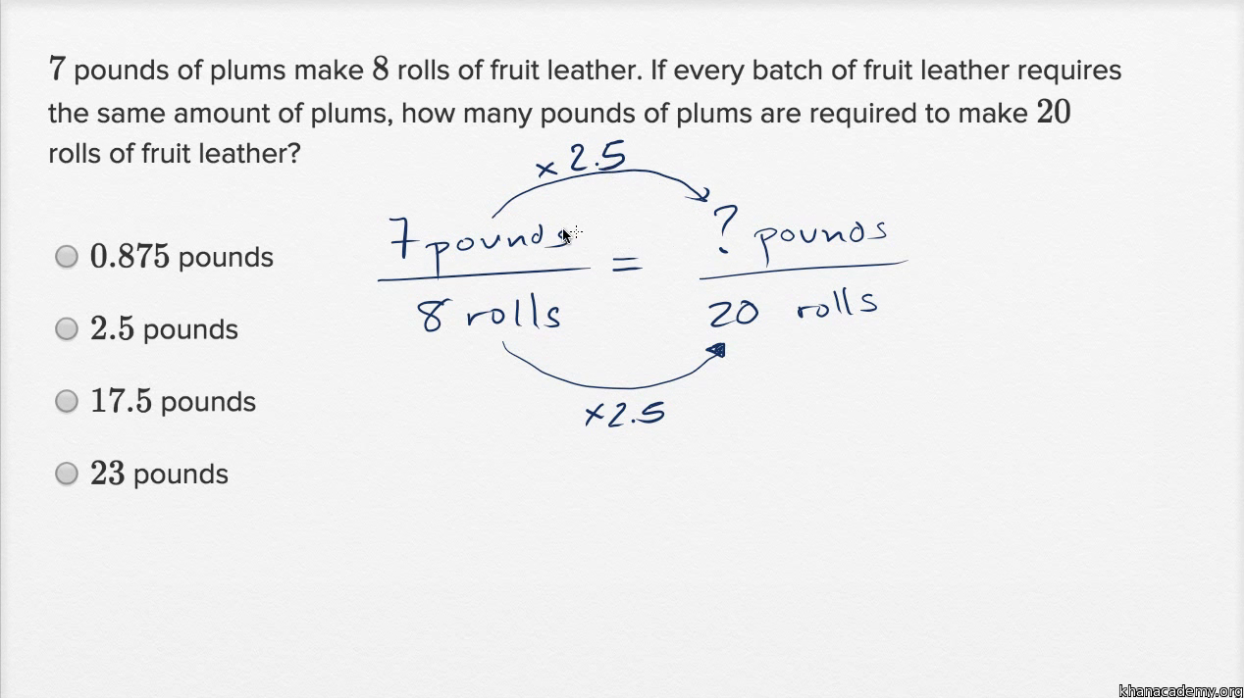
    In general, the SAT math tests fewer concepts/topics than the ACT math, specifically, less than 10% of SAT questions are on geometry and the SAT has fewer trigonometry questions than the ACT. However, the SAT math does have an emphasis on word problems and data analysis. Many parts of the SAT math include several questions off of one scenario.

    For example:
    The following is an example SAT algebra problem is from Khan Academy.
    Screen Shot 2019-07-08 at 2.12.27 PM

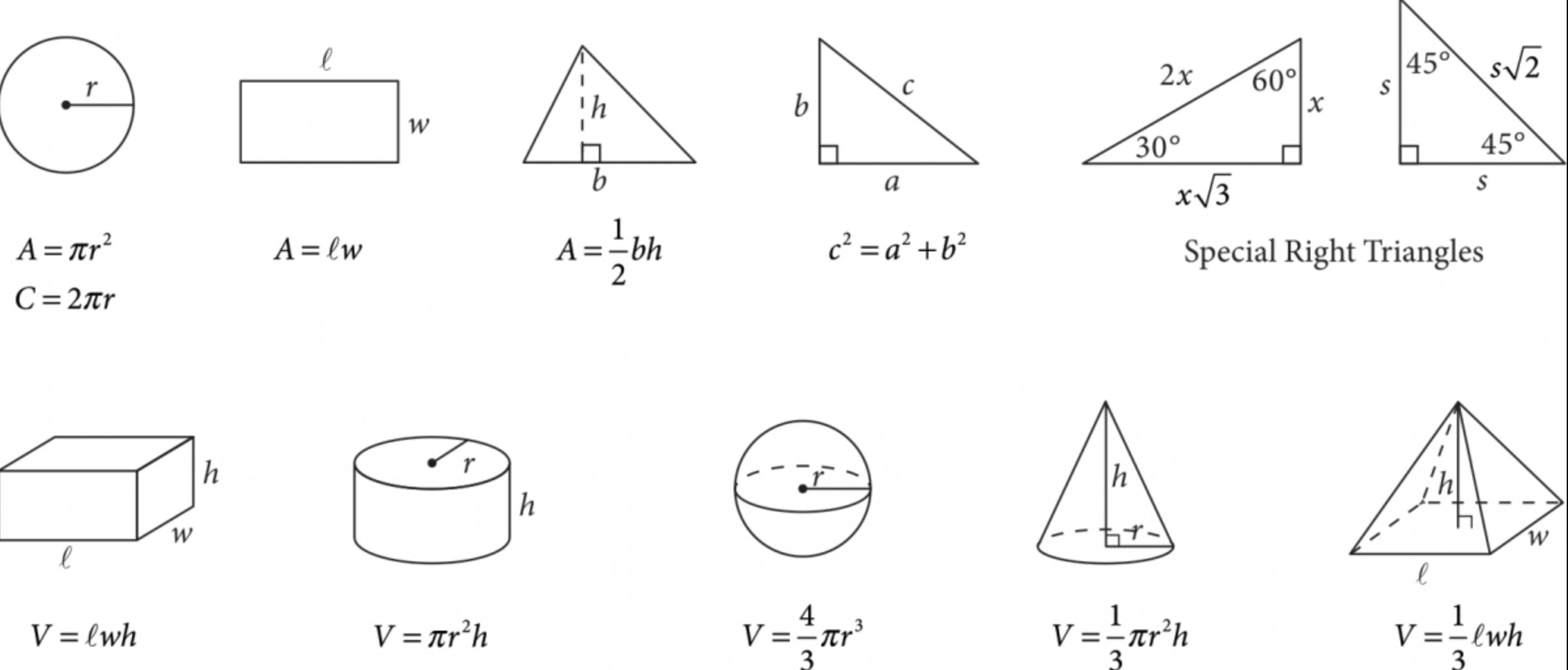
    The SAT will always give you a formula box at the beginning of the Calculator and No Calculator section, but we still suggest memorizing certain formulas in order to maximize time spent on solving the problems and checking your answers. The following image from the College Board shows some important formulas to remember:
    Screen Shot 2019-07-08 at 2.15.32 PM

    One unique thing about the SAT compared to the ACT is that there are 13 grid-in questions which is about 22% of the SAT math section. Unlike the multiple choice, you can’t really guess on these. You have to come up with an answer to the problem.

    ACT Question Types

    Like the SAT, the ACT math is also fairly straightforward. Generally, they aren’t as wordy as some SAT math questions. However, as noted earlier, there is a heavier emphasis on gemoetry (35-40% of questions on ACT Math) and trigonometry on the ACT math than the SAT math. Also, the ACT math covers a wider range of topics than the SAT math like trigonometry, matrices, and logarithms.

    For example:
    The following is an example ACT trigonometry problem is from Magoosh.
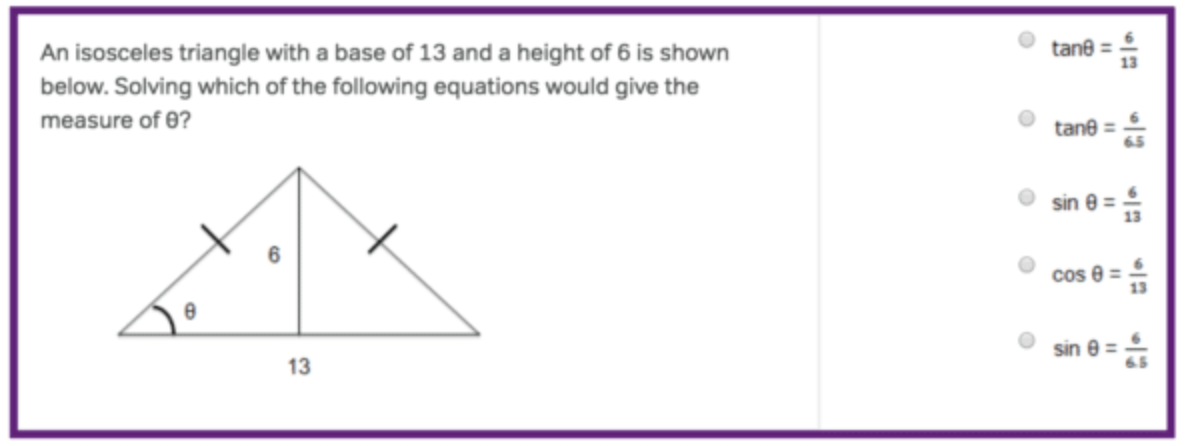
    Screen Shot 2019-07-08 at 2.22.56 PM

    Unlike the SAT, you will not be given a formula box so you have to memorize all the necessary formulas before the test day.

    The trade-off between the SAT and ACT is that the ACT covers a wider range of topics but covers each topic less extensively than the SAT. Topically, if you’re strong in geometry or trigonometry, the ACT might be better suited for you. If you can’t remember formulas and need to rely on given formulas, the SAT might be better suited for you.

    Scoring

    Imagine this. It’s the fourth quarter. It’s a tied game, and there’s one second left on the clock. Your coach calls a play, and the ball gets inbounded to you. What do you do? You chuck it up. Really. What’s there to lose? You miss, and you might get chirped a little bit, but if you hit, you’ll be the hero.

    This analogy may seem weird, but it is an applicable testing strategy to maximize your score in both the SAT and the ACT. Both the SAT and the ACT combine the correct and incorrect answers to give you a raw score which is then converted into a scaled score. This section in this guide will break down the scoring processes of both the SAT and the ACT.

    SAT Scoring

    As explained earlier, the SAT Math section is broken down into multiple-choice questions and grid-in questions. For each question, you will receive the following on your raw score:
    – +1 for each correct answer
    – +0 for each incorrect answer

    Note: there is no penalty for incorrect or blank answers on the SAT. That’s why on the multiple-choice questions, when the shot clock is running down and you’re unsure about a question, you should just chuck it up and guess one of the answers. Hitting on one of these guesses won’t make you a hero but at least you’ll get a higher SAT score!

    The total raw score on the SAT Math section converts to a scaled score between 200-800. With the scaled scores, you don’t have to get every question right in order to achieve a perfect score on the math section. They’re scaled. The scaled score will then give you your percentile ranking which is basically how you stack-up compared to the rest of the people that took the SAT.

    For example, if you scored in the 50th percentile, you’re dead on average: you scored better than 50% of all people who took the SAT and 50% scored higher than you.

    Fun fact: For each multiple choice question guess, you’re getting 0.25 points added to your raw score (the points are not actually added to your raw score) so for every 4 multiple choice questions that you guess, on average, you’re getting 1 point added to your raw score!

    Note: A good test taking strategy is to cross out answers you know are incorrect. If you cross out an incorrect answer, those guesses discussed above result in even more “points” added to your raw score!

    ACT Scoring

    Every question on the ACT Math section is multiple-choice with five different answer choices. For each question on the ACT, you will earn the following on your raw score:

    • +1 raw point for each correct answer
    • +0 raw point for each incorrect answer

    Note: Like the SAT, there is no penalty for incorrect or blank answers on the ACT so the same guessing strategy for questions you’re unsure of as mentioned earlier applies here too. However, since the ACT has 5 answer choices rather than 4, the guessing strategy is less effective.

    The total raw score on the ACT converts to a scaled score out of 36. Like the SAT, you don’t have to get every question right in order to achieve a perfect score. The score is scaled. The scaled score will then give you your percentile ranking which is how you stack-up against everyone else that took the ACT.

    SAT Scores and Percentiles vs. ACT Scores and Percentiles

    As discussed earlier, since the scores are scaled, you don’t have to get every answer correct in order to achieve a perfect score. Like-wise, the perecentile you place in isn’t the exact percentage of questions answer correctly. The following information shows the amount and percentage of questions you must answer correctly on the SAT and ACT math sections to score in certain percentiles. All the data below comes from current SAT and ACT percentiles and official SAT and ACT practice tests.
    SAT:

    SAT Raw Score SAT Scaled Score SAT % Questions Correct SAT Percentiles
    20 450 34% 25th percentile
    28 520 48% 50th percentile
    39 600 67% 75th percentile
    52 730 90% 95th percentile

    ACT:

    | ACT Raw Score | ACT Scaled Score | ACT % Questions Correct | ACT Percentiles |
    | ———- | ———- | ———- | ———- |
    | 16-18 | 16 | 27-30% | 25th percentile |
    | 25-26 | 19 | 42-43% | 50th percentile |
    | 34-36 | 24 | 57-60% | 75th percentile |
    | 49-50 | 30 | 82-83% | 95th percentile |
    Note: Since every SAT/ACT test is unique, these are only general guidelines for the raw score and % questions answered correctly needed to get a certain scaled score and certain percentile. Basically, this means there might be a small range in either positive or negative direction needed to achieve a certain scaled score and percentile.

    As shown in the data above, you need to answer more questions right on the SAT to achieve a certain percentile than the ACT. In general, you would need to answer 2-3 more questions correctly on the SAT to achieve the same percentile on the ACT.

    Summary

    The SAT Math:

    • Divided into two parts: No Calculator and Calculator
    • No Calculator appears third, after Writing and language, Calculator appears fourth, after No Calculator
    • No Calculator: 75 seconds per question, Calculator: 87 seconds per question
    • Wrong answers aren’t penalized (guess!)
    • Consists of multiple-choice questions (4 answer choices) and grid-in questions (give your own answer)
    • Formula box provided in the beginning of both No Calculator and Calculator section
    • Heavy emphasis on algebra, less so on geometry and trigonometry
    • More emphasis on word problems and data analysis than the ACT

    The ACT Math:

    • Appears second, right after the English section
    • 60 questions, 60 minutes (1 minute per question)
    • Calculator allowed through the whole section
    • Only multiple-choice, each multiple-choice having 5 answer choices
    • Wrong answers aren’t penalized (guess!)
    • No formulas provided
    • Larger emphasis on geometry (35-40% of questions)and trigonometry
    • Wider range of topics covered than the SAT, but each topic covered less extensively

    So Which One Should I Take?

    Ultimately, the test you should take comes down to which test suits your strengths. Each test has its own pros and cons for each specific person. If unsure, we recommend taking at least one practice SAT and ACT practice test and comparing your scores. I know. What was the point of reading this guide then? At the end of the day planning can only get you so far, and the results from your practice is the only thing that can give you definitive results. If one score is drastically higher than the other, there you go.

    However, that’s not to say that just because you score higher in one math section than the other, that’s your test. What matters is total score so even if you score lower on the SAT math than the ACT math, as long as your SAT overall score is higher, then the SAT is the better option for you.

    Standardized testing is all about balance, from balancing your time while taking the test to answer the most amount of questions correctly to finding which test holistically best suits you. Just because you’re strong on one area, doesn’t mean you’ll crush the SAT/ACT.

    And even if you don’t achieve the scores you desire, just note that only practice, diligence, and preparation will help you crush the SAT/ACT and achieve your testing potential. For more in-depth teaching about the SAT/ACT, check out our website Prepmedians to learn more about everything you need to know!