Category: Uncategorized

  • How is the ACT Scored?

    How is the ACT Scored?

    Overview

    If you’re just starting to prepare for the ACT, you’re probably wondering how the ACT is scored. It’s important to fully understand how the ACT scores their exams in order to get a leg up and prep in a more efficient and effective manner. Below we’ve outlined how the ACT is scored, section by section, with official ACT scoring charts. This post has been updated to reflect the new ACT with Enhancements.

    The ACT has three mandatory sections: English, Math, and Reading. It has two optional sections: Science and Writing. Each section is given a scaled score between 1 and 36. Your composite score is the average of your three mandatory section scores (English, Math, and Reading).

    An important note: THERE IS NO POINT DEDUCTION FOR ANSWERING INCORRECTLY ON THE ACT – so NEVER leave a question blank.

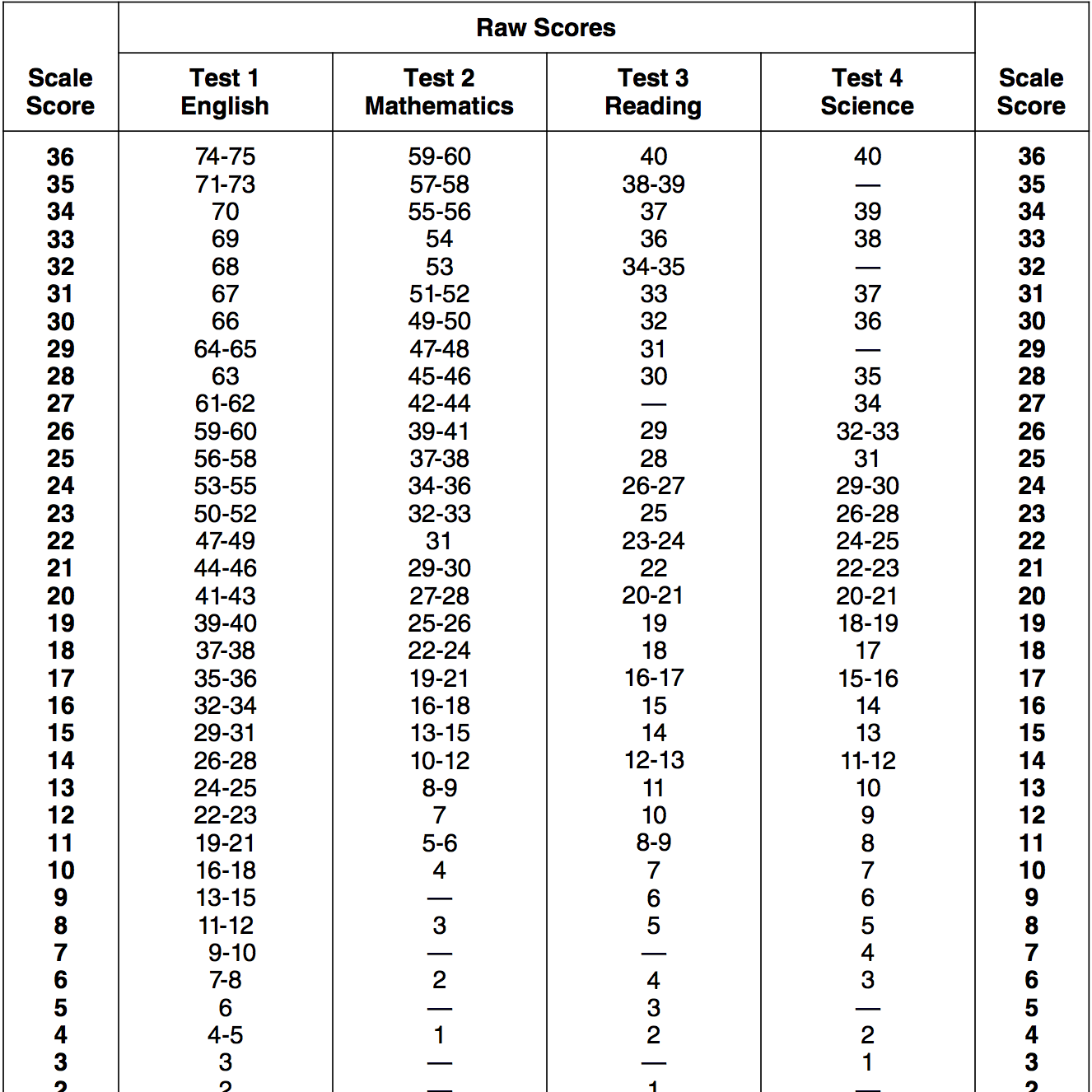
    How are raw ACT scores converted into scaled scores?

    A raw score is the total number of questions you answer correctly, which is converted into a scaled score between 1 and 36. The ACT scales scores to make sure their scores are consistent across multiple test dates.

    How is a composite score calculated?

    We know that each section receives a scaled score between 1 and 36, but how do these three section (English, Math, and Reading) scores combine to create a composite score? It’s actually quite simple; your composite score is the average of your three section scores, rounded up to the nearest whole number. Two-thirds of a point or more is rounded up, one-third of a point is rounded down.

    For example, if you got a 24 on English, 25 on Math, and a 24 on Reading:
    (24 + 25 + 24) / 3 = 24.33.

    So your composite score would be a 24.

    What are ACT subscores?

    Not only does the ACT provide a composite score and individual section scores, you will also receive subscores in the three mandatory sections (English, Math, Reading). This will give you some more information about your strengths and weaknesses.

    Subscores are scaled from your raw score, but range from 1 to 18. There is no direct relationship between subscores and final scaled scores. Subscores merely provide more information about your performance and what you might need to improve.

    Do not worry about ACT subscores. Colleges care more about your ACT composite score, and will also look at your individual section scores.

    ACT Section Breakdown

    How many raw points possible are on each section? How are scores calculated?

    English

    The English section on the ACT has 50 multiple choice questions, 10 of which are non-scored Field questions, so the highest raw score one could achieve is a 40. Questions answered incorrectly or left blank are simply not added on to the raw score.

    Math

    The Math section on the ACT has 45 multiple-choice questions, 4 of which are non-scored Field questions, so the highest raw score one could achieve is a 41. Questions answered incorrectly or left blank are simply not added on to the raw score.

    Reading

    The Reading section on the ACT has 36 multiple-choice questions, 9 of which are non-scored Field questions, so the highest raw score one could achieve is a 27. Questions answered incorrectly or left blank are simply not added on to the raw score.

    Science

    The Science section on the ACT is optional and has 40 multiple-choice questions, 6 of which are non-scored Field questions, so the highest raw score one could achieve is a 34. Questions answered incorrectly or left blank are simply not added on to the raw score.

    Here’s a quick plug:

    To all the frustrated juniors, seniors, and parents out there, are you tired of grinding through prep books? I, too, was not blessed with natural ACT test taking skills. To prep, I spent a whole month, every single day for 8 hours, nonstop grinding… that’s a lie. For me, I struggled to stay focused and motivated, and it was a painful and drawn-out process. I remember countless times where I had read through a page of an ACT English prep book, and then realized that I had processed absolutely nothing! Fantastic, time to re-read the page for the 7th time. Nobody wants to read through a list of mind-numbing grammar rules. To be blunt, it’s just awful. Prepmedians, however, really changes the game. With sketch comedy, rap, music, and more, ACT and SAT test prep is taught in a much more engaging and entertaining way – not to mention the Saturday Night Live level of production (seriously, check it out here). With fundamental concepts and test-specific strategies interwoven into each lesson module, you can laugh your way to your dream score. Check us out at Prepmedians.com!

    ACT Writing

    The ACT also offers an additional writing section that occurs after the Science section. The writing section is NOT multiple choice – you will be writing the essay by hand. The essay is evaluated by two graders who score your essay from 1-6 based off of four domains; the highest score you can get per domain is 12. Your Writing score is a number between 2 and 12, calculated from the average of your four domain scores.

    One question asked rather frequently: Will the Writing or Science scores affect my composite score? The answer is no. The composite score solely consists of English, Math, and Reading. People take ACT Science and Writing depending on what their colleges or scholarships or majors require.

  • ACT English Section: What You Need to Know

    ACT English Section: What You Need to Know

    What is in the English section?

    The English section of the ACT tests your knowledge of standard English language conventions, elements of writing, and language. You will have 45 minutes to complete 75 multiple-choice questions. The test contains five passages, each with a set of varied questions that will test your understanding of the mentioned topics.

    How to Prepare?

    One way to know where to start would be to take a practice test to see what categories within the English section are your strengths and weaknesses. You can solidfy your strengths because they tend to be small mistakes that can be easily fixed. Then you can find lessons, like the videos in Prepmedians to learn the weaker topics more thoroughly. Because what tops test prep through comedy and music in Prepmedians? Another way would be to learn all the topics addressed in the test from the easier fundamental grammar rules to the more difficult structure rules. The breakdown of the topics are listed below for reference.

    Grammar:

    Excelling in the grammar rules tested by the ACT is essential in doing well in the ACT English section. ACT tends to test grammar rules repeatedly. These topics are applied by everyone on a day to day life from talking to texting. It would be useful to formally learn these topics through the entertaining videos in Prepmedians. Understanding and learning these topics would allow you to ace the mechanics questions in the English section.

    Grammar/Mechanics topics:

    • Parts of Speech
    • Independent/Dependent Clauses
    • Punctuation
    • Pronouns
    • Verb Tenses and Forms
    • Subject and Verb Agreement
    • Prepositions
    • Comma Rules
    • Wordiness/Redundancy
    • Possessives
    • Parallelism
    • Dangling Modifiers

    Substance and Structure:

    These questions are different from the grammar questions as they test your reading comprehension and your ability to analyze texts. The main strategy to tackle these questions is to be able to identify what the question is asking you to do. This is a step above knowing the English conventions. To be able to excel in these questions, it is necessary to know the strategies you need to know for each type of question. These top scoring strategies to tackle all types of structure and substance question can be found in Prepmedians.

    Substance and Structure Topics:

    • Main Idea
    • Theme
    • Add/Delete
    • Transitions
    • Placement/Relevance
    • Author’s goal/technique

    Takeaways and Tips:

    • The ideal time to spend on each passage would be…9 minutes.
    • Mechanics questions should take approximately 30 seconds.
    • Substance and Structure questions should take approximately 1 minute.
    • Choosing any answer would give you a 25% better chance than not choosing an answer (guess!!).

    Checkout Prepmedians to learn these topics more in depth and get more of these tips and takeaways!