Author: kalyanrm

  • How to Engage Students More Effectively: Edutainment

    How to Engage Students More Effectively: Edutainment

    Edutainment…

    … is a portmanteau of the words “education” and “entertainment” that refers to products and technology that merge education with entertainment. In our new and growing digital age, young people and students are drawn to edutainment. Edutainment makes learning fun, and we young people love to have fun.

    “But, learning isn’t supposed to be fun!”
    “How much will you actually be able to ‘learn’ if you’re busy having fun?”
    “Why can’t you just tough it out and grind through?”

    These are a few examples of common doubts, criticisms, and questions skeptics have about edutainment — they are all perfectly valid. In fact, I had plenty of reservations myself at first. If I’m going to study, I don’t want any distractions. And if I want to have fun and relax, I don’t want to be thinking about studying or schoolwork. But there are times when it feels as if education isn’t fun enough and entertainment isn’t serious enough.

    If one can mix in entertainment with education at the right balance, information can be absorbed in a more efficient and effective way. The amusement and fun hold our attention as we are simultaneously processing information.

    Not convinced? I’ll give an example: the alphabet song.

    We all know how the song goes, “A, B, C, D, E, F, G… X, Y, and Z. Now, I know my ABCs…”. Now imagine having to memorize that without the tune. It’d be significantly more challenging and would slip out of your mind if you didn’t recite it on a regular basis.

    Academic research has shown that engaging the amygdala (the emotional part of the brain) can influence the hippocampus, which is the brain’s memory center. By singing along to the tune — which happens to be the same as “Twinkle, Twinkle, Little Star” and “Baa, Baa, Black Sheep” — the amygdala is engaged, allowing one to experience emotions that make memories stronger. Through this, one is able to commit information to memory in a more efficient and effective manner.

    And that’s how Prepmedians works! Students are better engaged through sketch comedy, rap, and music. The fun and entertaining videos keep students more focused and able to absorb information. The content in the videos are the product of 5,000 hours of private tutoring experience and careful analysis of SAT and ACT exam content. What students get from Prepmedians is more than just ACT or SAT test taking strategies (though these are indeed heavily emphasized), students are taught the fundamental skills of grammar, math, and reading that they will use for the rest of their lives.

    Prepmedians is proof that edutainment works

    As part of my onboarding, I completed the entire ACT English section on Prepmedians. I was pleasantly surprised to find that while the videos were really funny on their own, I had also finally managed to learn correct semi-colon and colon usage! After my Prepmedians experience, I was sold on edutainment; edutainment is not only fun but actually even more effective because it is fun.

  • Who’s vs. Whose: What’s the Difference?

    Who’s vs. Whose: What’s the Difference?

    Definitions

    To start out, let’s first define who’s and whose:
    who’sa contraction for “who is” or “who has”
    whosea possessive pronoun meaning belonging to or associated with which person

    Roots: Who and Whom

    To understand when to use each word, one must first start from the basics: the root. The pronouns used as the roots of “who’s” and “whose” are “who” and “whom.”

    “Who” and “whom” are similar in that you’ll use both when describing a person or when asking a question about which person did something. The difference between “who” and “whom” is that “who” is a subject pronoun so it will be the subject of a clause or phrase and “whom” is an object pronoun. Some other examples of subject pronouns are he/she/they, and some other examples of object pronouns are him/her/them.

    For more help in the difference between “who” and “whom,” check out our website Prepmedians to learn more about proper usage between the two.

    “Who” Examples:

    • Who called my phone?
    • Who asked you to prom?
    • Jed, who is a musician, only talks about being a musician.

    “Whom” Examples:

    • Whom does Hannah B. love?
    • Whom do you believe?
    • Do you know with whom you will go to prom?

    Usage and Examples

    Who’s

    “Who’s” is a contraction of either “who+is” or “who+has.” The apostrophe in the contraction of who’s stands for the missing letters of either “i” in who is or “ha” in who has.

    Examples:
    – Who’s on right now? (Who is on right now?)
    – Who’s your one true love? (Who is your one true love?)
    – Who’s gone outside of the country? (Who has gone outside of the country?)

    Whose

    Whose is a possessive pronoun used in questions when asking about ownership of one thing.

    Examples:
    – Whose side are you on?
    – Whose phone are you calling?
    – Whose song are you listening to?

    By the way, “Whose mans is that?” does use the proper “whose”! Also, if you’re concerned about getting to a level where someone says that about you, we can help get you there on the grammar end, but you’ll probably want to look to an actual dating coach like our friend Blaine Anderson.

    #1 Tip for Remembering the Difference

    It’s helpful and all to remember the definitions of “whose” and “who’s,” but proper usage can still elude even those who memorized the definitions. Here are 2 tips for remembering which one to correctly use:

    Plug in “who is” or “who has”

    One easy way for proper usage is to replace “who’s” or “whose” with “who is” or “who has.” Think of our first examples. Whose mans is this? and Who’s Hannah going to give a rose to on the next week of the Bachelorette? Now replace both “whose” and “who’s” with “who is” or “who has” and see if it makes sense.

    Who is man is this? No, that doesn’t seem right. It sounds too clunky so “whose” is probably the right choice.
    Whom is Hannah going to give a rose to on the next week of the Bachelorette? Yep, seems right. “Who’s” is the correct choice here.

    Key Takeaways:

    • “Who’s” is a contraction of “who is” or “who “has.”
    • Whose is a possessive pronoun and another way of saying “belonging to whom”.
    • Plug in “who is” or “who has” in the blank; if either works, then “who’s” is the correct answer.

    For more help on homophones, tricky pronouns, or any other material you might encounter on the SAT/ACT, check out our website Prepmedians to learn more about everything you need to know!

  • Is Your Brain Hungry?

    Is Your Brain Hungry?

    I know, I know. You probably don’t want to read another article telling you what foods you should and shouldn’t eat before you take the test, but bare with me here. This is simply one day, actually less than that if you really think about it, so I’m sure you can manage. Whether you like it or not, diet is essential when it comes to learning, but let’s be clear. I’m not talking about a temporary fad diet like a high-protein diet or a low-carb diet. I’m talking about a healthy, nutritional diet.

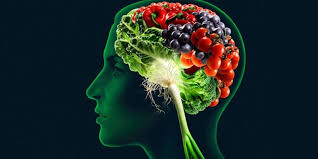
    Along with knowledge, the brain needs food to keep the mind sharp, heighten your attention span, and be cognitively flexible. And what’s more important than a sharp mind when taking a test? By increasing the level of healthy foods you eat, you can help boost your test scores. Here are some food options you can eat to improve your brain’s health and get a leg up on exam day:

    1. Fish

    Fish are a great source of Omega-3 protein which is an excellent source for quality brain functioning. This will help you stay sharp during your test because Omega-3s contribute to maintaining concentration abilities, brain capacity, and general alertness. The best fish to eat for Omega-3 protein are Wild Alaskan salmon, or other types of oily, cold-water fish like herring, mackerel, sardines, and trout. Now, I’m not expecting you to get up and pry open a can of sardines or cook fish to eat for breakfast, but eating a meal with fish the night before taking the test should suffice.

    For my vegan and vegetarian friends, there are some vegetable sources to get your Omega-3s. For example, hemp protein and flax seeds work just fine, but make sure the flax seeds are grounded; otherwise you won’t retain any of the nutrients.

    2. Complex Carbohydrates

    If you didn’t know by now, the brain is like an engine and it needs fuel, or sugar to properly function. However, the simple sugars in sodas and candy that comes to mind burn up too quickly to give you the steady energy needed to power through this long test. Therefore, the best source of fuel is complex carbohydrates because the brain needs twice as much energy as the rest of the cells in your body. Complex carbohydrates are minimally processed fruits, vegetables, and grains.

    They say the blacker the berry, the sweeter the juice; but for antioxidants, a good general rule is the darker the fruit or vegetable, the healthier it is for you. Why? Because antioxidants are most beneficial when obtained through whole foods like blueberries, artichokes, prunes, apples, etc. Pack these types of food to snack on during breaks on the day of the test. Take advantage of these brain breaks to consume food that will keep your energy up as opposed to junk food that will cause a crash. If you’re not the snacking type, incorporate some complex carbohydrates into your morning pre-test breakfast by eating some steel cut oatmeal and some berries. Yum!

    3. Protein

    I, myself, am a protein kind of gal wink wink. And from that, I found that protein is vital for sustained energy. Plus, eating meals that include protein are recommended because protein lessens anxiety which can be pretty useful come test day. I mean, am I right? Or am I right? Some great sources of protein include eggs/egg whites, soy food products, lean meats, milk etc. That shouldn’t be too hard for you to include in your diet even though most of us eat these foods on the regular. Protein-heavy foods help to increase mental clarity and concentration, so just eat eggs for breakfast and I’m sure you’ll do eggcellent on the test! Yeah, that was corny, but what’s done is done.

    4. Water

    It’s a no brainer (pun intended… Okay, I’ll stop…) that proper hydration is important for brain functionality, so drink plenty of water the night before and the morning of the test. To ensure hydration even further, bring a water bottle to the test and take a couple of sips any time you feel hungry or slightly fatigued. The last thing we want is for you to be dehydrated during the exam because that alone can diminish concentration and drain your physical energy. #StayThirstyMyFriends.

    Keep in mind that…

    You shouldn’t rely on healthy eating habits alone to boost your test scores or focus on your academics. That’s why you have Prepmedians to guide you on the path to success on these standardized tests. Hey, that rhymed! Anyways, fixing your diet is a great way to maintain optimal mental performance, and who knows, you may even develop a new healthy lifestyle!

  • How is the ACT Scored?

    How is the ACT Scored?

    Overview

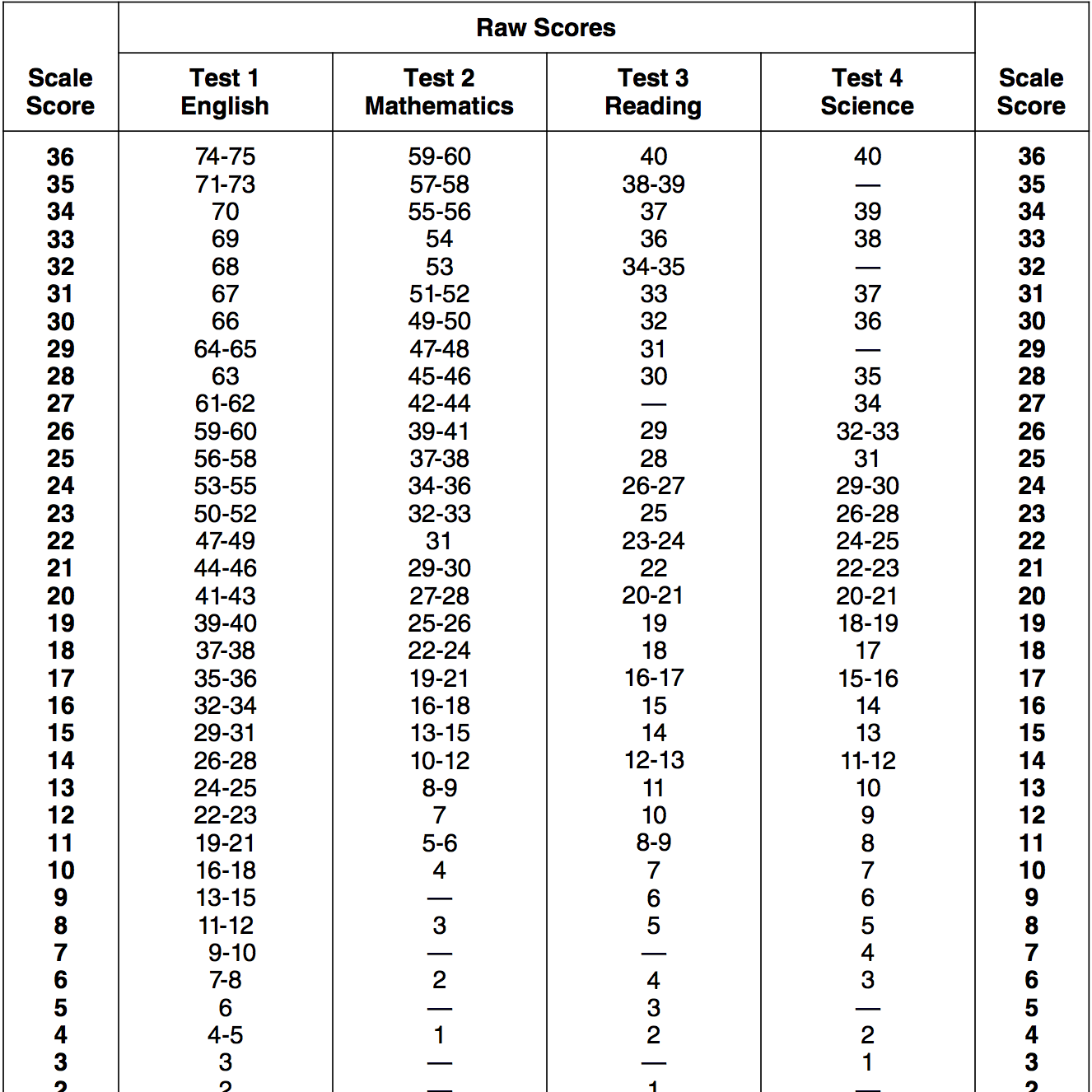
    If you’re just starting to prepare for the ACT, you’re probably wondering how the ACT is scored. It’s important to fully understand how the ACT scores their exams in order to get a leg up and prep in a more efficient and effective manner. Below we’ve outlined how the ACT is scored, section by section, with official ACT scoring charts. This post has been updated to reflect the new ACT with Enhancements.

    The ACT has three mandatory sections: English, Math, and Reading. It has two optional sections: Science and Writing. Each section is given a scaled score between 1 and 36. Your composite score is the average of your three mandatory section scores (English, Math, and Reading).

    An important note: THERE IS NO POINT DEDUCTION FOR ANSWERING INCORRECTLY ON THE ACT – so NEVER leave a question blank.

    How are raw ACT scores converted into scaled scores?

    A raw score is the total number of questions you answer correctly, which is converted into a scaled score between 1 and 36. The ACT scales scores to make sure their scores are consistent across multiple test dates.

    How is a composite score calculated?

    We know that each section receives a scaled score between 1 and 36, but how do these three section (English, Math, and Reading) scores combine to create a composite score? It’s actually quite simple; your composite score is the average of your three section scores, rounded up to the nearest whole number. Two-thirds of a point or more is rounded up, one-third of a point is rounded down.

    For example, if you got a 24 on English, 25 on Math, and a 24 on Reading:
    (24 + 25 + 24) / 3 = 24.33.

    So your composite score would be a 24.

    What are ACT subscores?

    Not only does the ACT provide a composite score and individual section scores, you will also receive subscores in the three mandatory sections (English, Math, Reading). This will give you some more information about your strengths and weaknesses.

    Subscores are scaled from your raw score, but range from 1 to 18. There is no direct relationship between subscores and final scaled scores. Subscores merely provide more information about your performance and what you might need to improve.

    Do not worry about ACT subscores. Colleges care more about your ACT composite score, and will also look at your individual section scores.

    ACT Section Breakdown

    How many raw points possible are on each section? How are scores calculated?

    English

    The English section on the ACT has 50 multiple choice questions, 10 of which are non-scored Field questions, so the highest raw score one could achieve is a 40. Questions answered incorrectly or left blank are simply not added on to the raw score.

    Math

    The Math section on the ACT has 45 multiple-choice questions, 4 of which are non-scored Field questions, so the highest raw score one could achieve is a 41. Questions answered incorrectly or left blank are simply not added on to the raw score.

    Reading

    The Reading section on the ACT has 36 multiple-choice questions, 9 of which are non-scored Field questions, so the highest raw score one could achieve is a 27. Questions answered incorrectly or left blank are simply not added on to the raw score.

    Science

    The Science section on the ACT is optional and has 40 multiple-choice questions, 6 of which are non-scored Field questions, so the highest raw score one could achieve is a 34. Questions answered incorrectly or left blank are simply not added on to the raw score.

    Here’s a quick plug:

    To all the frustrated juniors, seniors, and parents out there, are you tired of grinding through prep books? I, too, was not blessed with natural ACT test taking skills. To prep, I spent a whole month, every single day for 8 hours, nonstop grinding… that’s a lie. For me, I struggled to stay focused and motivated, and it was a painful and drawn-out process. I remember countless times where I had read through a page of an ACT English prep book, and then realized that I had processed absolutely nothing! Fantastic, time to re-read the page for the 7th time. Nobody wants to read through a list of mind-numbing grammar rules. To be blunt, it’s just awful. Prepmedians, however, really changes the game. With sketch comedy, rap, music, and more, ACT and SAT test prep is taught in a much more engaging and entertaining way – not to mention the Saturday Night Live level of production (seriously, check it out here). With fundamental concepts and test-specific strategies interwoven into each lesson module, you can laugh your way to your dream score. Check us out at Prepmedians.com!

    ACT Writing

    The ACT also offers an additional writing section that occurs after the Science section. The writing section is NOT multiple choice – you will be writing the essay by hand. The essay is evaluated by two graders who score your essay from 1-6 based off of four domains; the highest score you can get per domain is 12. Your Writing score is a number between 2 and 12, calculated from the average of your four domain scores.

    One question asked rather frequently: Will the Writing or Science scores affect my composite score? The answer is no. The composite score solely consists of English, Math, and Reading. People take ACT Science and Writing depending on what their colleges or scholarships or majors require.