Author: kalyanrm

  • SAT vs ACT: Which One Should You Take?

    SAT vs ACT: Which One Should You Take?

    SAT or ACT?

    Parents and students start the college process by comparing the SAT and ACT tests. The SAT and ACT cover generally the same topics, and both scores are used for college admissions decisions and the awarding of merit based scholarships.

    In the past, schools on the coasts generally gravitated towards the SAT while those in the midwest preferred the ACT. Now, however, the college application landscape has changed and schools have become increasingly flexible; both tests are now widely accepted across all US colleges.

    Don’t let the question of SAT or ACT keep you up at night! Know the basics about each test, your strengths and weaknesses as a test taker, and focus on!

    Comparing the SAT and ACT:

    The ACT has a Science section and the SAT does not, but on the ACT Science is now optional.

    The SAT is fully digital and adaptive. You take it in the Bluebook app, and a calculator is allowed on every math question.

    Aspect SAT ACT
    Why Take It Colleges use SAT scores for admissions and merit-based scholarships. Colleges use ACT scores for admissions and merit-based scholarships.
    How You Take It Fully digital. You test in College Board’s Bluebook app on a laptop or tablet, at a test center. Paper or online at the test center, depending on the date and the site.
    Test Structure Reading and Writing, then Math. Each section is split into two modules. English, Math, Reading, then optional Science. Optional Writing comes last.
    Length 2 hours, 14 minutes plus a 10-minute break 2 hours, 5 minutes for the three core sections. 2 hours, 45 minutes if you add Science. Writing adds another 40 minutes.
    Adaptive? Yes. How you do on the first module of a section decides whether the second module is harder or easier. No. Every student sees the same questions in the same order.
    Reading Short passages, usually a paragraph, with one question each, mixed in with the grammar questions. 36 questions across four passage sets.
    Science None as its own section, though charts and data show up inside Reading and Writing and Math. Optional since 2025. 40 questions in 40 minutes, testing how you read experiments, charts and tables rather than science you memorized.
    Math Algebra, advanced math, problem solving and data analysis, plus a smaller slice of geometry and trigonometry. Algebra, geometry, trigonometry, probability and statistics.
    Calculator Policy Allowed on every math question. Bluebook has a Desmos graphing calculator built in, or you can bring your own approved one. Allowed on every math question.
    Formula Sheet Provided, and you can pull it up on screen at any point during Math. Not provided. You memorize your formulas.
    Essay None. College Board discontinued the SAT Essay in 2021. Optional Writing test, scored 2 to 12. It does not count toward your composite.
    How It’s Scored Scored on a scale of 400 to 1600, with each of the two sections worth 200 to 800. Composite of 1 to 36, which is the average of English, Math and Reading only. Science is reported separately and pairs with Math for a STEM score.

    compiled from current College Board and ACT test specifications

    Here’s an interesting analogy comparing the two tests:

    The ACT is like lifting a 5 pound weight ten times while the SAT feels like lifting 25 pound weights twice. Both are quite draining, but in different ways. The ACT is extremely fast paced while the SAT requires you to think more and deeply.

    Important note: Be sure to look carefully at admission preferences and requirements to double check which of the tests your prospective college accepts.

    According to the College Board, while both tests measure what you learned in high school, the SAT is a better indicator of skills you will actually need to succeed in college and beyond. Instead of focusing on how well you can recall information, the SAT emphasizes one’s ability to apply it in real world scenarios. This is why the SAT provides everyday math formulas while the ACT expects you to memorize them.

    Test Format

    Structure and Timing SAT ACT
    Testing time 2 hours, 14 minutes 2 hours, 5 minutes core. 2 hours, 45 minutes with Science. Add 40 minutes for optional Writing.
    Structure 2 sections, 2 modules each 3 core sections, plus optional Science and optional Writing
    Number of questions 98 131 core, or 171 with Science
    Time per question About 1 minute, 22 seconds on average About 57 seconds on average
    Score range Composite 400 to 1600, with Reading and Writing and Math each 200 to 800 Composite 1 to 36 from English, Math and Reading. Science and STEM scores reported separately. Writing domain scores 2 to 12.
    Section length and timing Reading and Writing: two 32-minute modules of 27 questions each, so 54 questions in 64 minutes. Math: two 35-minute modules of 22 questions each, so 44 questions in 70 minutes. English: 50 questions in 35 minutes. Math: 45 questions in 50 minutes. Reading: 36 questions in 40 minutes. Science (optional): 40 questions in 40 minutes.

    compiled from current College Board and ACT test specifications

    Test Timing

    The SAT gives you 98 questions and the ACT gives you 131 in its three core sections, so timing is one of the most important things to weigh when you pick a test. You get roughly 1 minute and 22 seconds per question on the SAT and roughly 57 seconds per question on the ACT. The gap used to be wider, because the shorter ACT introduced in 2025 cut the question count without cutting the time by as much. Reading in particular went from about 53 seconds per question to about 67.

    One more thing worth knowing before you choose: the SAT is adaptive, so the second module of each section adjusts to how you did on the first. The ACT is not. If you like the idea of a test that meets you where you are, that is a point for the SAT. If you would rather see a fixed test you can practice against exactly, that is a point for the ACT.

    A little bit stressed out?

    I feel you. Test taking is honestly one of the worst things about the college process in my experience. We love spending summertime huddled over practice tests and test prep books and watching everybody else have fun. Are you feeling this FOMO? Do you find yourself “reading” through grammar rules only to realize that you’ve actually just been looking at the words and not processing anything? It happens to the best of us. Want to crush the ACT or SAT in the next few weeks? We got you. Prepmedians teaches ACT and SAT test prep through entertaining and engaging ways with sketch comedy, music, rap, and more. We’ll get you through those boring summer study days in no time. Check us out today!

  • SAT Math vs. ACT Math: The Ins and the Outs

    SAT Math vs. ACT Math: The Ins and the Outs

    What’s in this guide?

    Which is easier? Which is faster? Which one am I more likely to score higher in?

    This guide will help pilot you in your search for which test to take, but ultimately, it comes down to which math section is right for you?

    In this guide, we’re going to break down the similarities and the differences between the SAT Math section and the ACT math section and help you decide which standardized test best suits you.

    Organization

    Before diving into the specifics, let’s first look at each math section from an aerial view and see how it’s structured.

    SAT Math Organization

    The SAT is fully digital. You take it in College Board’s Bluebook app at a test center, and it has two sections that always appear in the same order: Reading and Writing first, then Math. The whole test runs 2 hours and 14 minutes, with a 10-minute break between the two sections, and Math takes up 70 minutes of that. Once a module is over you cannot go back to it. Time management is key.

    Here’s an overview of the SAT Math section:

    SAT Math Order of Appearance on Test # of Questions Total Time Time per Question
    Module 1 3rd (after both Reading and Writing modules) 22 35 minutes 95 seconds
    Module 2 4th 22 35 minutes 95 seconds

    Note: The Time per Question column is only a general guideline. On average you get about 95 seconds per question in each module, but you should spend more on some and less on others.

    The big thing to understand about the digital SAT is that it is adaptive. Math module 1 is a mix of easy, medium and hard questions. How you do on it decides whether module 2 is the harder version or the easier version, and that in turn sets the ceiling on your Math score. In practice this means module 1 matters more than it looks like it should. Do not burn all your time on one stubborn question early.

    A calculator is allowed on every single math question. Bluebook has a Desmos graphing calculator built in, and you can also bring your own approved calculator. The no-calculator section that older prep books talk about no longer exists; College Board retired it when the test went digital in 2024.

    You also get more time per question on SAT Math than on ACT Math, which is worth weighing if checking your work is what saves you (we’ll come back to this later in the guide).

    ACT Math Organization

    The ACT has three core sections that always appear in the same order: English, Math, Reading. Science is now optional and comes fourth if you take it, and optional Writing comes last. The three core sections take 2 hours and 5 minutes, or 2 hours and 45 minutes if you add Science. Like the SAT, once a section is over you cannot go back to it. Time management is key.

    Here’s an overview of the ACT Math section:

    ACT Section Order of Appearance # of Questions Total Time Time Per Question
    Math 2nd (after English) 45 50 minutes 67 seconds

    Note: The Time per Question column is only a general guideline. On average you get about 67 seconds per question on ACT Math.

    These numbers changed with the shorter ACT that rolled out in 2025. Math went from 60 questions in 60 minutes to 45 questions in 50 minutes, so you actually get a little more time per question than students did on the old test, and answer choices dropped from five to four. That second change matters more than it sounds: a blind guess is now a 1-in-4 shot instead of 1-in-5, and crossing out even one wrong choice pays off faster. ACT also cut back on long word problems. If your prep book says 60 questions in 60 minutes with five choices, it is out of date.

    The ACT Math section runs straight through with no break inside it, and it still appears right after English and right before Reading.

    Design-wise, everyone has their own preferences, so the “better” test design is the one that best works for you. If you want more time per question to solve problems and check your work, the SAT is better for you. If you would rather see a fixed, predictable test that does not change difficulty on you mid-section, the ACT is better for you.

    Question Types

    Although many of the topics covered in the SAT Math section and ACT Math section are similar, the way they are presented are drastically different. The following section will hopefully provide clarity on what to expect in the math sections when taking the SAT or ACT

    SAT Question Types

    The SAT math section is fairly straightforward that cover a broad range of topics, specifically focusing on algebra.
    In general, the SAT math tests fewer concepts/topics than the ACT math, specifically, less than 10% of SAT questions are on geometry and the SAT has fewer trigonometry questions than the ACT. However, the SAT math does have an emphasis on word problems and data analysis. Many parts of the SAT math include several questions off of one scenario.

    For example:
    The following is an example SAT algebra problem is from Khan Academy.
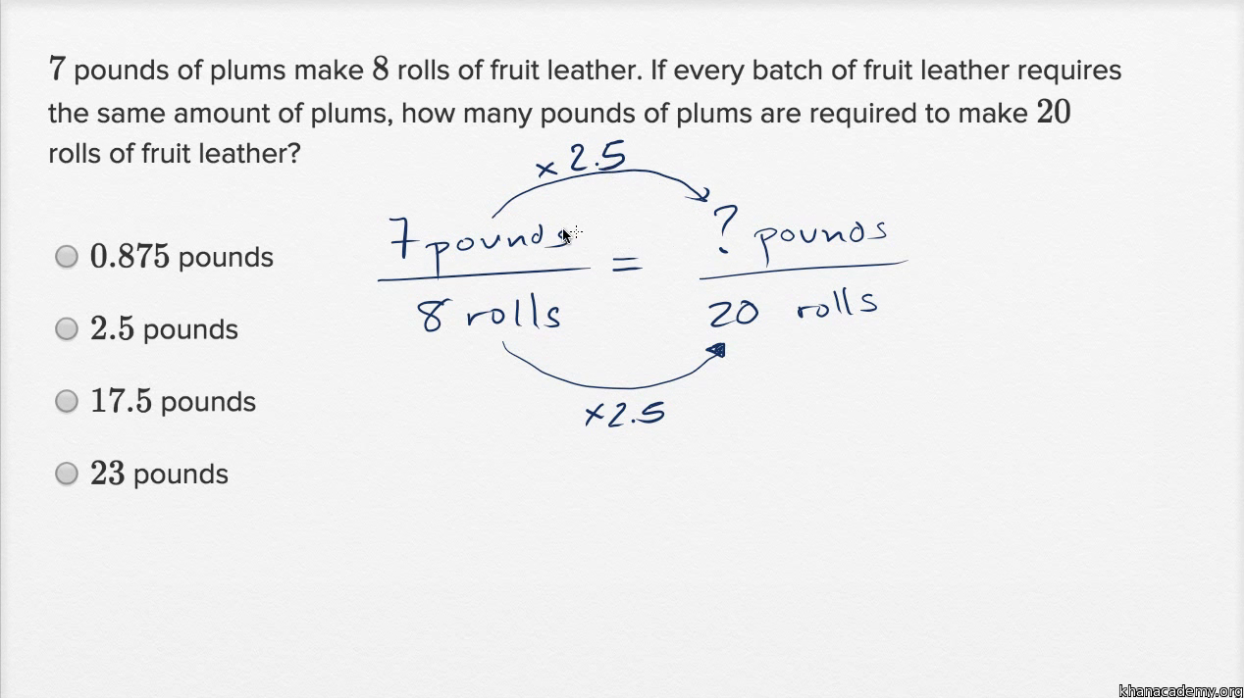
    Screen Shot 2019-07-08 at 2.12.27 PM

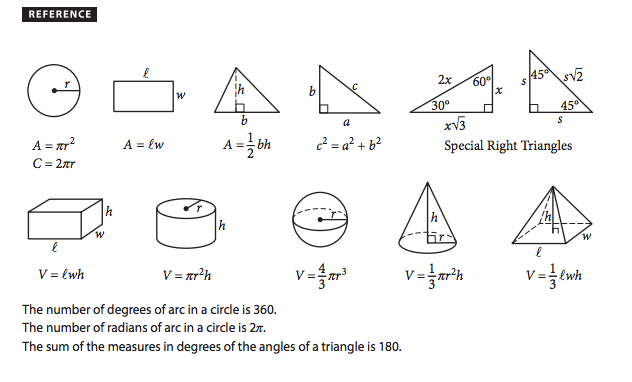
    The SAT gives you a reference sheet of formulas that you can pull up on screen at any point during Math, but we still suggest memorizing the common formulas in order to maximize time spent on solving the problems and checking your answers. The following image from the College Board shows some important formulas to remember:
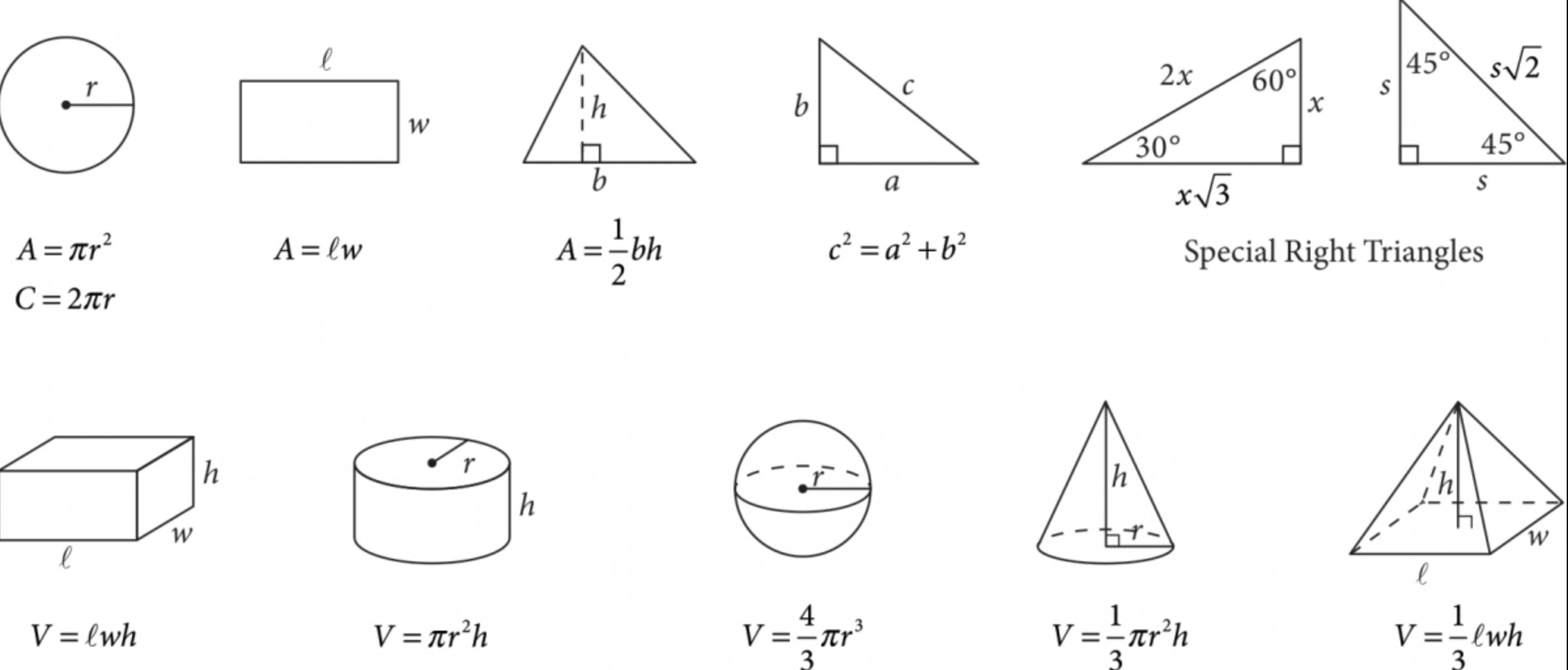
    Screen Shot 2019-07-08 at 2.15.32 PM

    One unique thing about the SAT compared to the ACT is student-produced response questions, better known as grid-ins. They are about 25% of SAT Math, roughly 11 of the 44 questions. Unlike the multiple choice, you can’t really guess on these. You have to come up with an answer to the problem.

    ACT Question Types

    Like the SAT, the ACT math is also fairly straightforward. Generally, they aren’t as wordy as some SAT math questions. However, as noted earlier, there is a heavier emphasis on geometry and trigonometry on the ACT math than on the SAT math. Also, the ACT math covers a wider range of topics than the SAT math like trigonometry, matrices, and logarithms.

    For example:
    The following is an example ACT trigonometry problem is from Magoosh.
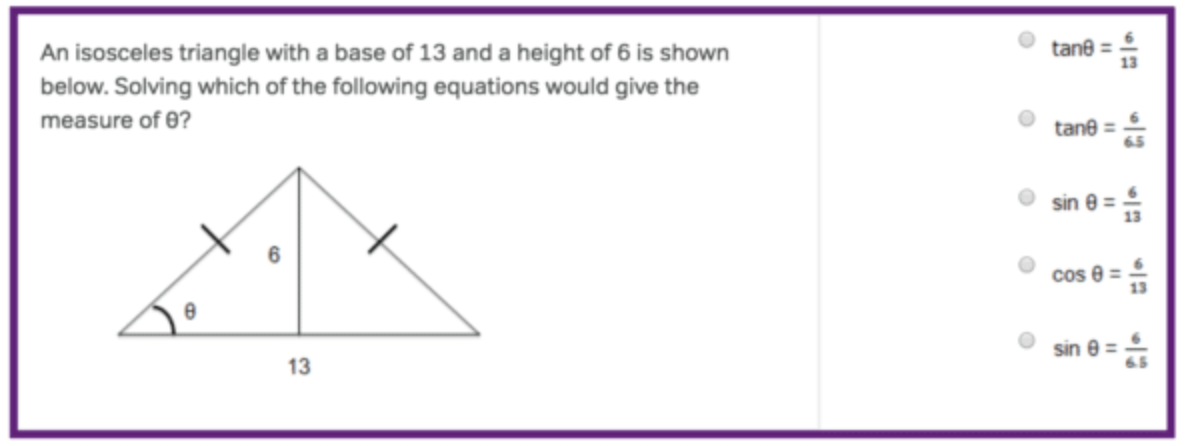
    Screen Shot 2019-07-08 at 2.22.56 PM

    Unlike the SAT, you will not be given a reference sheet, so you have to memorize all the necessary formulas before test day. That did not change with the shorter ACT.

    The trade-off between the SAT and ACT is that the ACT covers a wider range of topics but covers each topic less extensively than the SAT. Topically, if you’re strong in geometry or trigonometry, the ACT might be better suited for you. If you can’t remember formulas and need to rely on given formulas, the SAT might be better suited for you.

    Scoring

    Imagine this. It’s the fourth quarter. It’s a tied game, and there’s one second left on the clock. Your coach calls a play, and the ball gets inbounded to you. What do you do? You chuck it up. Really. What’s there to lose? You miss, and you might get chirped a little bit, but if you hit, you’ll be the hero.

    This analogy may seem weird, but it is an applicable testing strategy to maximize your score in both the SAT and the ACT. Both the SAT and the ACT combine the correct and incorrect answers to give you a raw score which is then converted into a scaled score. This section in this guide will break down the scoring processes of both the SAT and the ACT.

    SAT Scoring

    As explained earlier, the SAT Math section is broken down into multiple-choice questions and grid-in questions. For each question, you will receive the following on your raw score:
    – +1 for each correct answer
    – +0 for each incorrect answer

    Note: there is no penalty for incorrect or blank answers on the SAT. That’s why on the multiple-choice questions, when the shot clock is running down and you’re unsure about a question, you should just chuck it up and guess one of the answers. Hitting on one of these guesses won’t make you a hero but at least you’ll get a higher SAT score!

    The total raw score on the SAT Math section converts to a scaled score between 200-800. With the scaled scores, you don’t have to get every question right in order to achieve a perfect score on the math section. They’re scaled. The scaled score will then give you your percentile ranking which is basically how you stack-up compared to the rest of the people that took the SAT.

    For example, if you scored in the 50th percentile, you’re dead on average: you scored better than 50% of all people who took the SAT and 50% scored higher than you.

    Fun fact: For each multiple choice question guess, you’re getting 0.25 points added to your raw score (the points are not actually added to your raw score) so for every 4 multiple choice questions that you guess, on average, you’re getting 1 point added to your raw score!

    Note: A good test taking strategy is to cross out answers you know are incorrect. If you cross out an incorrect answer, those guesses discussed above result in even more “points” added to your raw score!

    ACT Scoring

    Every question on the ACT Math section is multiple-choice with four different answer choices. (It was five until the test was shortened in 2025.) For each question on the ACT, you will earn the following on your raw score:

    • +1 raw point for each correct answer
    • +0 raw point for each incorrect answer

    Note: Like the SAT, there is no penalty for incorrect or blank answers on the ACT so the same guessing strategy for questions you’re unsure of as mentioned earlier applies here too. And now that ACT Math has four answer choices rather than five, blind guessing is worth the same on both tests: a 1-in-4 shot.

    The total raw score on the ACT converts to a scaled score out of 36. Your Math scaled score is one of the three that get averaged into your composite, along with English and Reading. Science no longer counts toward the composite; if you take it, it is reported on its own and also combines with Math into a STEM score. Like the SAT, you don’t have to get every question right in order to achieve a perfect score. The score is scaled. The scaled score will then give you your percentile ranking which is how you stack-up against everyone else that took the ACT.

    SAT Scores and Percentiles vs. ACT Scores and Percentiles

    Because scores are scaled, you do not have to get every answer correct to hit a high score, and the percentile you land in is not the same as the percentage of questions you got right.

    What we will not do here is hand you a raw-score conversion chart. Those charts get passed around a lot and they are close to useless, for two reasons. First, every test form scales differently. A raw 39 is not a fixed scaled score; it depends on how hard that particular form was. Second, both tests have been redesigned since most of those charts were written, so the raw-score totals they are built on no longer exist. SAT Math is 44 questions now, not 58, and ACT Math is 45, not 60.

    The honest version is this: take an official full-length practice test, score it with the conversion table that comes with that specific test, and use the result as your baseline. College Board publishes full practice tests inside Bluebook, and ACT publishes official practice material for the shorter format. Those are the only conversions that will tell you anything real.

    For rough orientation while you plan, the SAT total average sits around 1050 and the ACT composite average sits around 19 to 20. Scoring above those puts you in the top half of test-takers. Anything more precise than that has to come from an official practice test.

    Summary

    The SAT Math:

    • Two adaptive modules of 22 questions, 35 minutes each, 44 questions in 70 minutes total
    • Comes after both Reading and Writing modules, so it is the second half of the test
    • About 95 seconds per question
    • Module 1 decides whether module 2 is the harder or easier version, which sets your score ceiling
    • Calculator allowed on every question, with Desmos built into Bluebook
    • Wrong answers aren’t penalized (guess!)
    • Multiple-choice questions with 4 answer choices, plus grid-ins (about 25% of the section) where you type your own answer
    • Reference sheet of formulas available on screen throughout Math
    • Heavy emphasis on algebra, lighter on geometry and trigonometry
    • More emphasis on word problems and data analysis than the ACT

    The ACT Math:

    • Appears second, right after the English section
    • 45 questions, 50 minutes (about 67 seconds per question)
    • Not adaptive. Everyone sees the same questions.
    • Calculator allowed through the whole section
    • Only multiple-choice, with 4 answer choices since the 2025 redesign
    • Wrong answers aren’t penalized (guess!)
    • No formulas provided
    • Larger emphasis on geometry and trigonometry
    • Wider range of topics covered than the SAT, but each topic covered less extensively
    • Counts toward your composite along with English and Reading, and pairs with Science for a STEM score if you take Science

    So Which One Should I Take?

    Ultimately, the test you should take comes down to which test suits your strengths. Each test has its own pros and cons for each specific person. If unsure, we recommend taking at least one practice SAT and ACT practice test and comparing your scores. I know. What was the point of reading this guide then? At the end of the day planning can only get you so far, and the results from your practice is the only thing that can give you definitive results. If one score is drastically higher than the other, there you go.

    However, that’s not to say that just because you score higher in one math section than the other, that’s your test. What matters is total score so even if you score lower on the SAT math than the ACT math, as long as your SAT overall score is higher, then the SAT is the better option for you.

    Standardized testing is all about balance, from balancing your time while taking the test to answer the most amount of questions correctly to finding which test holistically best suits you. Just because you’re strong on one area, doesn’t mean you’ll crush the SAT/ACT.

    And even if you don’t achieve the scores you desire, just note that only practice, diligence, and preparation will help you crush the SAT/ACT and achieve your testing potential. For more in-depth teaching about the SAT/ACT, check out our website Prepmedians to learn more about everything you need to know!

  • How Much Does the SAT Cost?

    How Much Does the SAT Cost?

    Updated for the 2026-2027 testing year. The SAT has been fully digital since 2024, and the SAT Essay and SAT Subject Tests no longer exist, so the fee structure is simpler than it was the last time most cost guides were written.

    Registration Costs

    Unfortunately, you can’t just show up test day and try to take the SAT without registering prior, and unfortunately, registering for the SAT costs money. Registering fees are comprised of mandatory fees and add-on fees, and these fees will be the bulk of the cost of the SAT.

    Here’s a table summarizing the mandatory SAT fees:

    Fee Cost
    Registration – SAT $68
    International fee (outside the U.S.) Added on top of the $68 base fee; the amount depends on your region

    And here’s a table summarizing the optional add-on SAT fees:

    Add-on Fees Cost
    Late fee (registering after the normal deadline) $38
    Waitlist fee (added to a test date waitlist after the late registration deadline) $0
    Change fee (switching your test center or test date) $34
    Cancellation fee $34, or $44 if you cancel late

    These costs can seem appalling for low-income families and can discourage taking the SAT multiple times, but those families shouldn’t be discouraged. The CollegeBoard offers fee waivers to certain students which gives the following benefits:
    – The SAT for free, twice
    – 2 free Question-and-Answer Service (QAS) or Student Answer Service (SAS) reports
    – Unlimited score reports to send to colleges
    – Waived application fees at these colleges
    – Free CSS Profile application to apply for financial aid at the colleges listed in the link above
    – No late registration fees for free tests
    – No international fees for free tests
    – Fee reductions for score verification reports

    A note on two things that used to be on this list: the SAT Essay and SAT Subject Tests no longer exist. College Board discontinued Subject Tests in January 2021 and the Essay in June 2021, so there is nothing to pay for and nothing to waive. If a prep book or an older article tells you to budget for either one, it predates those changes.

    To determine whether you are eligible for a fee waiver, you have to fit one of the following:

    • Enrolled in or eligible to participate in the National School Lunch Program (NSLP)
    • Your family’s annual income falls within these Income Eligibility Guidelines
    • You’re enrolled in a federal, state, or local program for low income states such as Upward Bound
    • Your family receives public assistance
    • You are a ward of the state or an orphan
    • You live in subsidized housing, live in a foster home, or are homeless

    To apply for a fee waiver, you have to contact your school counselor or a representative of a community-based organization. Even if you’re home-schooled, you still have to contact a local high school counselor. This process takes some time so it is recommended to apply for a fee waiver well before the SAT test dates you’d like to take.

    Score Report Costs

    After taking the SAT, you want to get your scores, know how well you did compared to everyone else, and be able to send out your scores. This table summarizes all possible post-test costs:

    Service Cost
    Receiving Scores Online $0
    Receiving Scores by Mail $0
    Receiving Scores by Phone $15 (per call)
    Score Report (first four reports you give to schools) $0
    Score Report (each additional report after first four reports) $15 (fee charged for each additional score report)
    Rush report request $31 (per order)
    Question and Answers Service $16
    Student Answer Service $16
    Score Verification $55
    Archived scores (scores from a test you took more than a year ago) $35

    Minimizing the Costs for the SAT

    As you can see, the SAT can cost quite a lot. All those little costs can add up, and if you don’t plan out which services you want to utilize ahead of time, you might end up wasting money and employing a service that you don’t need. Here are some tips to help minimize the costs for the SAT.

    Take the Test Early

    I know starting the college application process early in your high school career is not the most fun you’ve ever had, but if you take the SAT last minute, you might end up scrambling to get official score reports to schools before application deadlines and have to pay the $31 fee for a rush order. Also, if you take the SAT early, you’ll have more test dates to be able to retake the SAT and get a higher score.

    Most SAT scores are released two to four weeks after test day. You should also consider the time it takes for colleges to receive your score reports (2-3 weeks). If you want to avoid those pesky rush order fees, your last SAT should be at least 5 weeks before your scores need to be in.

    Register Early

    If you see the Registration Costs section, you’ll see that a late registration fee is $38. If you register late, that is more than half the cost of the test itself for a task that takes ten minutes. If you register ahead, not only do you save money, but you also ensure that you’ll have a spot during that test date and that you’ll also have more time to study for the SAT.

    Use Your Free Score Reports

    The first your score reports you send to schools are free if you specify the schools you’d like to send your scores to early enough. If you already know your dream top 4 schools, then list those four schools as early as registration or as late as the Monday 9 days after the test date. This will save you up to $60!

    Also, if you know which schools you want to apply to Early Decision (ED) or Early Action (EA), then list those schools for your free score reports. Not only are these deadlines earlier than normal application deadlines, but if you get into a school ED or EA, then you have the option to forgo the rest of the college application process and attend the school you got into ED/EA the next fall (if applying ED, you have a binding commitment so you’re forced to forgo the rest of the college application process)! What this means is that if you were planning on applying to multiple colleges, you no longer have to pay the additional score report fee of $15 per school.

    Utilize the Fee Waiver if Eligible

    As mentioned earlier, if you fall into any of the criteria for being eligible for a fee waiver, then you should apply for a fee waiver. You would get almost every service the SAT has for free. Read earlier in the article to learn more about what you get with a fee waiver and what criteria you need to fit in order to be eligible for a fee waiver.

    Registering and Receiving Scores Online

    cellphone

    The cellular phone has ruined our society. When you’re hanging out with friends or family, are you truly enjoying their company or are you wasting time aimlessly scrolling through your phone? We need to go back to the good old days.

    All jokes aside, phones are really convenient and helpful in our daily lives, but when it comes to the SAT, they only add on more fees. Registering by phone instead of registering online costs $15 and receiving scores by phone costs $15 per call. That’s at least $30 that you’re spending for the “convenience” of your phone rather than just doing things online where you spend $0.

    Prepare and Do Well on the SAT

    The majority of us take the SAT multiple times, which adds more costs and stress to this process, but there’s a simple fix: just ace the SAT the first time you take it, and you don’t have to worry about ever taking it again. You don’t have to worry about utilizing all the tips above a second, a third, or a fourth time. You don’t have to worry about more hours preparing for the SAT. And you don’t have to worry about another Saturday morning (and by the transitive property, another Friday night) spent on taking the SAT. It’s that simple!

    Although this is pretty unrealistic and unlikely, you should always rigorously prepare for your SATs. An extra half an hour a day is minimal work in the short-run, but you can potentially save a lot of money and time in the long-run. “Success is 90% preparation, 10% perspiration.”

    To help prepare for the SAT, we recommend Prepmedians. Not only do we effectively teach the concepts that will appear on the SAT so that you’ll be able to crush the SAT come test day, but we also present the information through an entertaining way where test prep is something enjoyable and as simple as watching a TikTok video rather than a burden. Prepmedians is affordable ($99/month, or $348 for 12 months, which works out to $29/month) compared to the prices of so many other tutoring companies and ways to prep. In particular, our founder Kalyan Ray-Mazumder who designed the curriculum would charge $400/hour when he was tutoring!

    And come test day, believe in yourself. Believe in your preparation. Believe that you can crush the SAT because once you do, you’ll be rewarded for all your hard work and effort when you get into your dream school!

  • How to Look at Your ACT and SAT Score?

    How to Look at Your ACT and SAT Score?

    How are the SAT and ACT Scored?

    Before trying to interpret the scores, you need to understand how each test is scored. The SAT has two sections, Reading and Writing, and Math. Each is worth up to 800 points, so your total score is out of 1600.

    The ACT has three scored sections that feed your composite: English, Math, and Reading. Each is scaled from 1 to 36, and those three are averaged to give you a composite out of 36. This changed in 2025. Science used to be the fourth section in that average; it is now optional, and if you take it, it is reported on its own and also combines with Math into a separate STEM score. Optional Writing is reported separately too, on a 2 to 12 scale.

    What is a Perfect Score?

    Don’t beat yourself up if you didn’t get a perfect score! Only about ~0.03% get a perfect score of 1600 on the SAT and about ~0.01% get a perfect score of 36 on the ACT. Our founder Kalyan Ray-Mazumder who wrote the curriculum for Prepmedians is one of the few people I know who got a perfect score on the test.

    The top tier American colleges like the Ivy-League schools are looking for scores above the 90th percentile. For the SAT, the 90th percentile score is approximately 1350 and for the ACT, the 90th percentile score is approximately 28.

    While a less than perfect score doesn’t dictate your chances with the top colleges and universities, a perfect score doesn’t determine your odds of getting in. There have been a lot of cases where students who have scored perfect scores, even multiple times, still were not able to get into some of the top tier schools. So, if the score you expected was not the score you got, don’t be disappointed.

    High SAT or ACT Score

    When interpreting SAT scores, know that the average total score has sat right around 1050 for years, split roughly evenly between the two sections. Scoring above 1050 puts you in the top half of test-takers. The ACT composite average has drifted down and now sits around 19 to 20, so scoring above 20 puts you in the top half there. Because the ACT composite no longer includes Science, do not assume a composite from a 2024 chart maps perfectly onto one earned today.

    While there is no one ideal score, you want to interpret the scores based on how selective the colleges in your list are. A 1200 or higher, along with other excellent application factors, should gain you admittance into many highly regarded American colleges. Depending on all the other factors of your application, an average score won’t keep you out of a good school.

    What’s the Worst Score?

    The low end for the SAT is a 400, and the lowest possible ACT score is 1.

    You have to work pretty hard to get a score that bad. Even if you don’t answer a single question, the companies that administer the tests are more likely to throw out your test, assuming an error was made, than to actually send it to any colleges.

    The question has been asked many times whether merely entering your name gets you the minimum SAT and ACT scores, and there seems to be no definitive answer.

  • Common Myths About ACT/SAT

    Common Myths About ACT/SAT

    Myth 1:

    The SAT is more accepted among colleges than ACT.

    NO! A common myth is that top-tier schools tend to prefer SAT over ACT. But in reality, all schools accept and look at ACT and SAT in the same scale. The preference of students to take SAT or ACT tends to rely on students’ resident states. The ACT is more popular in the Midwest than the SAT, considering many states in the Midwest require mandatory ACT testing. Students from the West or the East coast tend to prefer the SAT over the ACT. So, the difference in proportion of ACT and SAT scores among the accepted pool in top-tier schools is caused more by the personal preference of students rather than by the preference of colleges.

    Myth 2:

    The October and December ACT/SATs are harder because more seniors tend to take them last minute.

    NO! There were comparative studies done about the average scores from one testing month to another and October had a lower average than May. Thus, the rumors about easier testing dates started running wild. But these testing dates keep changing. Sometimes it’s December with the lowest average and sometimes it’s June. Any student might find one test slightly easier than the other. One section or even one question could seem easier. But that opinion is different for every student. So, don’t pick a date based on this myth. Instead, pick a date that best works with your schedule.

    Myth 3:

    ACT is only for people who have a good science background.

    NO! And as of 2025 the Science section is optional anyway, so this myth has even less to stand on than it used to. If you do take Science, it tests your ability to read and analyze passages, charts, tables, and graphs. It is not trying to test your in-depth knowledge and understanding of all areas of science. While it does present passages and experiments of science fields like biology, chemistry and others, it is your reasoning and reading comprehension skills that will actually help you in this section (not your hard science knowledge!).
    P.S. The SAT tests your ability to analyze data and graphs too. It does so in a more hidden way by mixing it with other sections.

    Myth 4:

    The ACT is “easier” than the SAT.

    NO! The ACT is not necessarily easier, it’s just that the questions tend to be more straightforward. Students who take the SAT and the ACT with an equal amount of preparation for both tend to score equivalently on both. The SAT used to have a no-calculator section, but that went away when the test went digital in 2024. A calculator is now allowed on every math question on both tests, and the SAT even builds a Desmos graphing calculator right into the app. It is worth exploring both tests to see which one is better for you! You can prepare for both at Prepmedians.

    Myth 4.5:

    Now that ACT Science is optional, you should skip it.

    Not so fast. Science no longer counts toward your ACT composite, which is the number most people mean when they say “my ACT score.” But some colleges and scholarship programs still ask for it, and some STEM programs look at the separate Science and STEM scores. It is an extra 40 minutes and a few extra dollars. Check the requirements at every school on your list before you register, because adding Science later is more annoying than just taking it. If you are aiming at engineering or a science major, take it.

    Myth 5:

    You have to spend a lot of money to do well on the ACT/SAT.

    NO! Sure, there are many test prep courses require you to spend a lot of money, sometimes even many thousands of dollars. And the cost is often positively correlated with the amount of time you spend. But it’s important to note that the ACT/SAT tests your knowledge gained from all your K-12 education. Most of the topics these tests focus on, like algebra, tend to be from earlier stages of schooling than later. So, none of the topics tested by ACT/SAT are completely new. Rather, they try to gauge how well you understand the fundamental topics. It is not worth paying someone thousands of dollars to have them reteach the content that you already know and waste hundreds of hours of valuable time in that process. Rather, your focus should be on reviewing the topics and finding strategies that would help you tackle the known but hidden patterns of the test. You will find a faster review of the necessary content and strategies, all taught through entertainment at an affordable price, at Prepmedians!

  • Prepmedians for Schools and Organizations

    Prepmedians for Schools and Organizations

    Prepmedians for Schools and Organizations

    Prepmedians makes SAT and ACT prep a blast for students across the country. Through the power of music and comedy, we make it easy and fun for students to study for their exams.

    We also work directly with schools, charter programs, nonprofits and counseling organizations that want to put a full test-prep course in front of their students without building one themselves. Here’s how a partner account works.

    We set the accounts up for you

    You do not create accounts, manage a roster tool, or hand your staff a new admin panel to learn. Send us your student list and we provision everything on our side:

    • An organization account for your school or program, with an administrator login for whoever is running it.
    • A student account for each name on your list, already attached to your organization.
    • Course access for each student, with the course you chose and the credentials ready to hand out.

    Adding a student mid-term is a message to us, not a support ticket.

    Access windows that match your term

    Every seat is set with a start date and an end date, so access opens when your term opens and closes when it closes. If you are running a fall SAT push that ends after the December test, that is exactly what the seat does. You are not buying an open-ended subscription that somebody has to remember to cancel, and there is nothing for a family to be surprised by on a credit card statement.

    You can see how students are doing

    Your administrator can see the students attached to your organization and the work they have done: which modules they have finished, how they scored on module quizzes, and where they are getting stuck. Each module ends in a quiz, and the report from that quiz breaks performance down by skill rather than just giving a number, which is the part that actually tells a teacher what to reteach.

    Reports can go to a parent or a staff member

    For each student you can give us a second email address, a parent, a guardian, a case manager, an advisor. That address gets a copy of the report every time the student finishes a module quiz. For programs where somebody outside the classroom is responsible for keeping a student on track, this is usually the single most useful thing we turn on.

    What students get

    The same thing every other Prepmedians student gets, which is the point. Over fifty hours of comedy-driven video lessons taught by Broadway performers and sketch comedians, full practice sets, an AI tutor that walks through questions with them, and worked video explanations. Content is kept current with the digital SAT and the shortened ACT, including the 2025 changes that made ACT Science optional and dropped it out of the composite score.

    A note on LMS single sign-on

    We previously offered single sign-on and automatic rostering through a third-party integration partner, covering LMS platforms such as Canvas, Schoology and Google Classroom. That integration has been retired and is no longer available. Partner accounts are now provisioned directly by us, from a student list you send. If your program previously reached Prepmedians through an LMS launch link, get in touch and we will move your students onto standard accounts.

    Getting started

    Tell us the students, the course, when your term starts and how long it runs, and we will take it from there. Reach out at info@prepmedians.com to set up a partner account.

  • The Clock Never Stops Ticking

    The Clock Never Stops Ticking

    If you’re anything like me when I was in high school, you reign supreme in procrastination nation. If there’s a class called “Procrastination 101,” you’d ace it easily, and the concept of time management is completely foreign to you. But time management isn’t what it is perceived to be — it has nothing to do with managing time. Why? Because you can’t actually manage time, can you? Time is ineluctable. The grains of sand fall and time marches on whether you like it or not. Therefore, “time management” is simply behavior management, and it’s about managing your productivity within the time you’re given.

    ACT Pacing and Time Management Strategies

    The ACT is an oxymoron in itself; it’s both a road trip AND a ride around the corner to the gas station – it’s a long test that one must move through very quickly. The ACT tests more than your knowledge. The exam is also a measure of your performance under pressure and, essentially, the implementation of the test-taking strategies you practiced. Let’s go through some strategies that will help you tackle the ACT without running out of time!

    Strategy 1: Budget Your Time

    I suggest getting an old-fashioned watch to help you keep track of your pacing, without the added cost of constantly looking up and calculating how many minutes you have left. When practicing for the exam, divide each of the tests into groups of problems. This way, you’ll know the proper amount of time that should be allotted to every type of problem on every page for each section. And if you can’t finish within that allotted amount of time, remember to keep moving because you may be able to come back to it later.

    Strategy 2: Know the Format for Every Test

    Always keep track of how many questions you have left. The number of questions per section does not change from test to test, so practice with the format in mind. Since the ACT was shortened in 2025, the counts are:

    • The ACT English section has 50 questions in 35 minutes (about 42 seconds each).
    • The ACT Math section has 45 questions in 50 minutes (about 67 seconds each).
    • The ACT Reading section has 36 questions in 40 minutes (about 67 seconds each).
    • The ACT Science section, which is now optional, has 40 questions in 40 minutes (about 60 seconds each).

    If you are working out of an older prep book that says 75 English questions and 60 Math questions, throw those pacing targets out. The shorter test gives you more time per question than the old one did, especially in Reading, which went from about 53 seconds per question to about 67. That is a real gift if pacing is what has been hurting you, but only if you practice against the current counts.

    This is all discussed in Alan’s article on the ACT test breakdown. Check it out here!

    Strategy 3: Easy Questions

    Don’t rush through the first half of each section. Instead, move quickly through the easy questions to save time for the harder questions at the end. You can also try skimming through the test, only stopping to do problems you are 100% certain on.

    Either way, you are choosing a method that leaves you more time to work on the harder problems. However, this does not guarantee that you’ll get to every single problem.

    Strategy 4: Answer ALL Questions

    Don’t let a few hard questions ruin your chance to finish all of them because you refused to “give up” on them! Remember that there’s no wrong answer penalty on the ACT test, so when it’s coming down to the wire and you have to answer the last couple of questions, always bubble in an answer. When I was in grade school, everyone would tell you to guess “C” for questions you didn’t know the answer to or questions you didn’t have the time to answer. However, it’s NOT true that always choosing C will give you a better rate of success when blind guessing because ACT answer keys are completely computer generated and randomized. The best strategy is to pick your favorite letter and stick with it. Could that be the letter C? Sure, go right ahead! Just remember to choose it every single time when blind guessing. This strategy on average and over a spread, will let you maximize your overall point-gain in comparison to randomized guessing. All in all, if you’re spending around two minutes or more on a single question, it’s time to guess and move on because every point helps!

    Remember that…

    The best way to know what to expect on the test is to practice, and I can’t express that enough. Timed practice is more valuable than untimed practice, so practice, practice, practice!

    You can practice time management and learn more about the ACT by visiting our Prepmedians website and working through our modules. Have fun!

  • Tips and Tricks for Each SAT Section

    Tips and Tricks for Each SAT Section

    Heads up: the SAT has been fully digital and adaptive since 2024. There is no longer a separate Reading section and Writing and Language section. Both live inside one Reading and Writing section made of two 32-minute modules of 27 questions each, and every question has its own short passage. The tips below have been updated for that format.

    SAT Reading and Writing Tips

    Tip 1: Pay Attention to Connotation and Context

    Look for words that indicate positive or negative connotation in the part of the passage that the question refers to. This will help you to eliminate at least a couple of choices even if you are not sure about the remaining answer choices.
    Context is also very important! Don’t just analyze the referred sentence in the question — look at the sentences above and below it too. Watch out for the contrast words! You should also pay attention to strong adjectives that might help you to determine connotation.

    Tip 2: Work the Short Passages One at a Time

    On the digital SAT, every Reading and Writing question comes with its own passage, usually a single paragraph, and that passage serves only that one question. The old paired “which choice provides the best evidence” questions are gone, and so is the habit of flipping back and forth across a long passage hunting for line references.

    Treat each question as a self-contained puzzle. Read the short passage once, decide in your own words what the answer should be before you look at the choices, and then find the choice that matches. Because the passages are so short, re-reading one costs you seconds, not minutes, so do not guess when a second read would settle it.

    One more thing the short-passage format gives you: questions inside each module are roughly grouped by type, moving from Craft and Structure and Information and Ideas into Standard English Conventions and Expression of Ideas. Once you notice you have crossed into grammar territory, you can switch into grammar mode and stay there.

    Tip 2.5: Respect Module 1

    The SAT is adaptive. How you do on the first module of Reading and Writing decides whether the second module is the harder version or the easier version, and that sets the ceiling on your section score. Module 1 is worth your best focus. Do not sandbag it planning to “lock in” later.

    SAT Math Tips

    Tip 3: Underline Key Parts of the Question

    Underline what you need to find in the question so you don’t get confused during the calculation process.
    Many students accidentally pick the trick answer choice because they lose track of the value that they were originally supposed to find. You can avoid this by underlining relevant parts of the question to maintain your focus.

    Tip 4: Memorize Formulas

    The SAT gives you a reference sheet of formulas that you can pull up on screen at any point during Math, but you will lose time and flow if you keep opening it. It is best to have the common formulas memorized beforehand and save the reference sheet for the ones you genuinely rarely use. This is a good reference from Khan Academy for some of the important formulas covered on the SAT.!9d6f82b33f4e0a6e192e74224a40976c332ddfbb

    SAT Grammar and Expression Tips

    Tip 5: Memorize Grammar Rules

    The grammar questions on the SAT, officially the Standard English Conventions questions, take a specific standardized approach, so it is useful to memorize the rules to reduce confusion. It’s always safer to know the exact rules than to just go by what “looks right” or “sounds right” to you. If you’re not used to some of the more archaic grammar rules tested on the SAT, you should memorize them. On the digital test there is no “NO CHANGE” option any more; you are given four complete versions of the underlined portion and you pick the one that works. That makes knowing the actual rule more important, not less, because you can no longer fall back on “the original sounded fine.” At prepmedians.com, we have a Need-to-Knows list of grammar rules with all of the grammar content you need to know to ace the section!

    Tip 6: Skim the Paragraph Before Answering Rhetorical Questions

    Expression of Ideas questions ask about purpose, transitions, and how ideas fit together rather than about a single grammar rule. They come at the end of each module, after the conventions questions.

    Two of them are worth naming. Transition questions give you a blank between two sentences and four connecting words. Do not pick by ear. Decide first what the relationship is (same direction, opposite direction, cause, example) and then choose the word that does that job. Rhetorical synthesis questions give you a bulleted list of notes and a stated goal, something like “emphasize a difference between the two studies.” The trap is that several choices are factually true; only one accomplishes the stated goal. Read the goal twice, then treat every choice as right-or-wrong against that goal alone.

    These tips are just to get your feet wet, but there are many more strategies that you can find at prepmedians.com where all the content and strategies are baked into our HD entertaining videos featuring Broadway singer-actors and sketch comedians.

  • Tips and Tricks for Each ACT Section

    Tips and Tricks for Each ACT Section

    Heads up: ACT shortened the test in 2025. English is now 50 questions in 35 minutes, Math is 45 questions in 50 minutes with four answer choices instead of five, Reading is 36 questions in 40 minutes, and Science is optional. Your composite is the average of English, Math and Reading only. The tips below have been updated for that format.

    ACT English Tips

    1: Choose the Most Concise Answer

    ACT English questions tend to test grammar rules and sentence structure in the most straightforward, logical way. So try to find the choice that provides all of the necessary information for the sentence to make grammatical sense…and nothing extra. The main goal of this is for the sentence to be clear and concise while being grammatically correct! One of our Prepmedians videos One KISS Is All It Takes covers this exact rule in more detail!

    2: Be Careful With “No Change” Answers

    Almost all the grammar questions have the option of “No Change.” This is a dangerous choice because if you aren’t aware of more obscure grammar rules, you might be tempted to choose it even when the sentence can be fixed. It is really important to double-check all other answers before settling on “No Change” as the correct choice. The best way to check all the options is to read the sentence with each option and decide. But “No Change” really is the correct answer around ~25% of the time, so don’t second-guess yourself if you are sure there isn’t an error. There are more strategies that can be found at prepmedians.com

    ACT Math Tips

    3: Pay Attention to Diagrams

    A lot of math questions tend to be accompanied with diagrams. It’s important to pay attention to these figures, as they tend to summarize all the details of the question while giving clues about which answer choices are the most logical. If a problem asks you to figure out an angle, for example, and some of the choices are acute while others are obtuse, you will be able to eliminate at least a couple of these answers just by looking at the diagram because they are drawn to scale (unless otherwise noted). If an answer is not supported by the diagram, it’s usually safe to cross it out. Even when diagrams are not part of the questions, you will be able to draw diagrams by yourself based on the details.

    4: Plug In Answers and Numbers

    If a question asks you to solve for x, simply plug each answer choice back into the original equation and see which one works. This will tell you which answer choice is the correct one without having to really solve the problem!
    For numbers, you’ll choose random numbers to plug into algebraic variables. This strategy lets you analyze the problem using real numbers instead of unknowns, and works best for questions with multiple variables. This could be useful when you are looking at the range of a function or inequalities.

    When solving really obvious questions, these strategies might slow you down instead of helping. So make sure you don’t waste your time using this strategy in questions you already know the answer for!

    ACT Reading Tips

    5: Start With Your Strengths

    The ACT Reading section is 36 questions in 40 minutes, and it is always structured the same way with four topic areas in the same order. Each topic corresponds to a passage or pair of passages.
    – Prose fiction/literary narrative
    – Social science
    – Humanities
    – Natural science

    If you have already taken practice tests and know the order of efficiency within the topics, start by reading the passage that correspond to the topic area in which you are most comfortable. The main purpose of this is to start with the topic you are able to read fast and analyze so you are not giving yourself a chance to get questions for that passage wrong. This way, you can get the questions that are easiest for you out of the way first and won’t risk running out of time before you have a chance to answer others.

    6: Skim Passages

    For some students, it might be manageable to read passages normally and still have enough time to finish the section, but you have to be a really quick and thorough reader in order to pull this off. The best strategy for most people is to skim the passages instead. In order to skim effectively, read the introduction and conclusion paragraphs as well as the first and last sentences of every body paragraph. This will give you a good overview of the main ideas and allow you to answer most questions. When you get to detail questions, you can then reread specific parts of the passage if necessary.

    ACT Science Tips

    First, a decision to make. Science has been optional since 2025 and no longer counts toward your composite. If you take it, it is reported on its own and also pairs with Math for a STEM score. Some colleges and scholarship programs still ask for it, and it costs only a few dollars and 40 extra minutes to add, so check every school on your list before you register. If you are heading toward a STEM major, take it. The tips below apply if you do.

    7: Do the Conflicting Viewpoints Section Last

    The conflicting viewpoints passage on ACT Science is usually the most time consuming for students. In case you’re not familiar with it, this part of the section asks you to read two or three passages that detail different viewpoints on a scientific issue. You’ll then answer questions about these viewpoints and how they relate to one another. Since this is more reading-intensive and can eat up a lot of time, it’s best to save this part for last so that you don’t end up missing other questions in the section that will be quicker and easier for you to answer.

    8: Rely On Visuals

    The ACT Science section has a lot of unfamiliar terminology and facts that make it seem overwhelming. The best way to attack those passages is to ignore the unfamiliar terms and go straight for the graphs, which should provide enough information for you to answer the majority of the questions you’re faced with. Most of the information you’re given is just extra stuff thrown in there to make this section seem more difficult than it really is. In reality, the science section is more about logical reasoning and data interpretation than it is about actually knowing any science. As long as you can read the graphs, you’ll be fine!

    Find out more detailed tips and strategies that can be used to excel in the test at Prepmedians

  • ACT English Section: What You Need to Know

    ACT English Section: What You Need to Know

    What is in the English section?

    The English section of the ACT tests your knowledge of standard English language conventions, elements of writing, and language. You will have 35 minutes to complete 50 multiple-choice questions, which works out to about 42 seconds per question. The section contains five passages, each with a set of varied questions that test your understanding of the topics above. These numbers changed when ACT shortened the test in 2025; it used to be 75 questions in 45 minutes. The section is shorter now, and you get a little more time per question than students used to.

    How to Prepare?

    One way to know where to start would be to take a practice test to see what categories within the English section are your strengths and weaknesses. You can solidfy your strengths because they tend to be small mistakes that can be easily fixed. Then you can find lessons, like the videos in Prepmedians to learn the weaker topics more thoroughly. Because what tops test prep through comedy and music in Prepmedians? Another way would be to learn all the topics addressed in the test from the easier fundamental grammar rules to the more difficult structure rules. The breakdown of the topics are listed below for reference.

    Grammar:

    Excelling in the grammar rules tested by the ACT is essential in doing well in the ACT English section. ACT tends to test grammar rules repeatedly. These topics are applied by everyone on a day to day life from talking to texting. It would be useful to formally learn these topics through the entertaining videos in Prepmedians. Understanding and learning these topics would allow you to ace the mechanics questions in the English section.

    Grammar/Mechanics topics:

    • Parts of Speech
    • Independent/Dependent Clauses
    • Punctuation
    • Pronouns
    • Verb Tenses and Forms
    • Subject and Verb Agreement
    • Prepositions
    • Comma Rules
    • Wordiness/Redundancy
    • Possessives
    • Parallelism
    • Dangling Modifiers

    Substance and Structure:

    These questions are different from the grammar questions as they test your reading comprehension and your ability to analyze texts. The main strategy to tackle these questions is to be able to identify what the question is asking you to do. This is a step above knowing the English conventions. To be able to excel in these questions, it is necessary to know the strategies you need to know for each type of question. These top scoring strategies to tackle all types of structure and substance question can be found in Prepmedians.

    Substance and Structure Topics:

    • Main Idea
    • Theme
    • Add/Delete
    • Transitions
    • Placement/Relevance
    • Author’s goal/technique

    Takeaways and Tips:

    • The ideal time to spend on each passage would be…9 minutes.
    • Mechanics questions should take approximately 30 seconds.
    • Substance and Structure questions should take approximately 1 minute.
    • Choosing any answer would give you a 25% better chance than not choosing an answer (guess!!).

    Checkout Prepmedians to learn these topics more in depth and get more of these tips and takeaways!