
What’s in this guide?
Which is easier? Which is faster? Which one am I more likely to score higher in?
This guide will help pilot you in your search for which test to take, but ultimately, it comes down to which math section is right for you?
In this guide, we’re going to break down the similarities and the differences between the SAT Math section and the ACT math section and help you decide which standardized test best suits you.
Organization
Before diving into the specifics, let’s first look at each math section from an aerial view and see how it’s structured.
SAT Math Organization
The SAT is fully digital. You take it in College Board’s Bluebook app at a test center, and it has two sections that always appear in the same order: Reading and Writing first, then Math. The whole test runs 2 hours and 14 minutes, with a 10-minute break between the two sections, and Math takes up 70 minutes of that. Once a module is over you cannot go back to it. Time management is key.
Here’s an overview of the SAT Math section:
| SAT Math | Order of Appearance on Test | # of Questions | Total Time | Time per Question |
|---|---|---|---|---|
| Module 1 | 3rd (after both Reading and Writing modules) | 22 | 35 minutes | 95 seconds |
| Module 2 | 4th | 22 | 35 minutes | 95 seconds |
Note: The Time per Question column is only a general guideline. On average you get about 95 seconds per question in each module, but you should spend more on some and less on others.
The big thing to understand about the digital SAT is that it is adaptive. Math module 1 is a mix of easy, medium and hard questions. How you do on it decides whether module 2 is the harder version or the easier version, and that in turn sets the ceiling on your Math score. In practice this means module 1 matters more than it looks like it should. Do not burn all your time on one stubborn question early.
A calculator is allowed on every single math question. Bluebook has a Desmos graphing calculator built in, and you can also bring your own approved calculator. The no-calculator section that older prep books talk about no longer exists; College Board retired it when the test went digital in 2024.
You also get more time per question on SAT Math than on ACT Math, which is worth weighing if checking your work is what saves you (we’ll come back to this later in the guide).
ACT Math Organization
The ACT has three core sections that always appear in the same order: English, Math, Reading. Science is now optional and comes fourth if you take it, and optional Writing comes last. The three core sections take 2 hours and 5 minutes, or 2 hours and 45 minutes if you add Science. Like the SAT, once a section is over you cannot go back to it. Time management is key.
Here’s an overview of the ACT Math section:
| ACT Section | Order of Appearance | # of Questions | Total Time | Time Per Question |
|---|---|---|---|---|
| Math | 2nd (after English) | 45 | 50 minutes | 67 seconds |
Note: The Time per Question column is only a general guideline. On average you get about 67 seconds per question on ACT Math.
These numbers changed with the shorter ACT that rolled out in 2025. Math went from 60 questions in 60 minutes to 45 questions in 50 minutes, so you actually get a little more time per question than students did on the old test, and answer choices dropped from five to four. That second change matters more than it sounds: a blind guess is now a 1-in-4 shot instead of 1-in-5, and crossing out even one wrong choice pays off faster. ACT also cut back on long word problems. If your prep book says 60 questions in 60 minutes with five choices, it is out of date.
The ACT Math section runs straight through with no break inside it, and it still appears right after English and right before Reading.
Design-wise, everyone has their own preferences, so the “better” test design is the one that best works for you. If you want more time per question to solve problems and check your work, the SAT is better for you. If you would rather see a fixed, predictable test that does not change difficulty on you mid-section, the ACT is better for you.
Question Types
Although many of the topics covered in the SAT Math section and ACT Math section are similar, the way they are presented are drastically different. The following section will hopefully provide clarity on what to expect in the math sections when taking the SAT or ACT
SAT Question Types
The SAT math section is fairly straightforward that cover a broad range of topics, specifically focusing on algebra.
In general, the SAT math tests fewer concepts/topics than the ACT math, specifically, less than 10% of SAT questions are on geometry and the SAT has fewer trigonometry questions than the ACT. However, the SAT math does have an emphasis on word problems and data analysis. Many parts of the SAT math include several questions off of one scenario.
For example:
The following is an example SAT algebra problem is from Khan Academy.
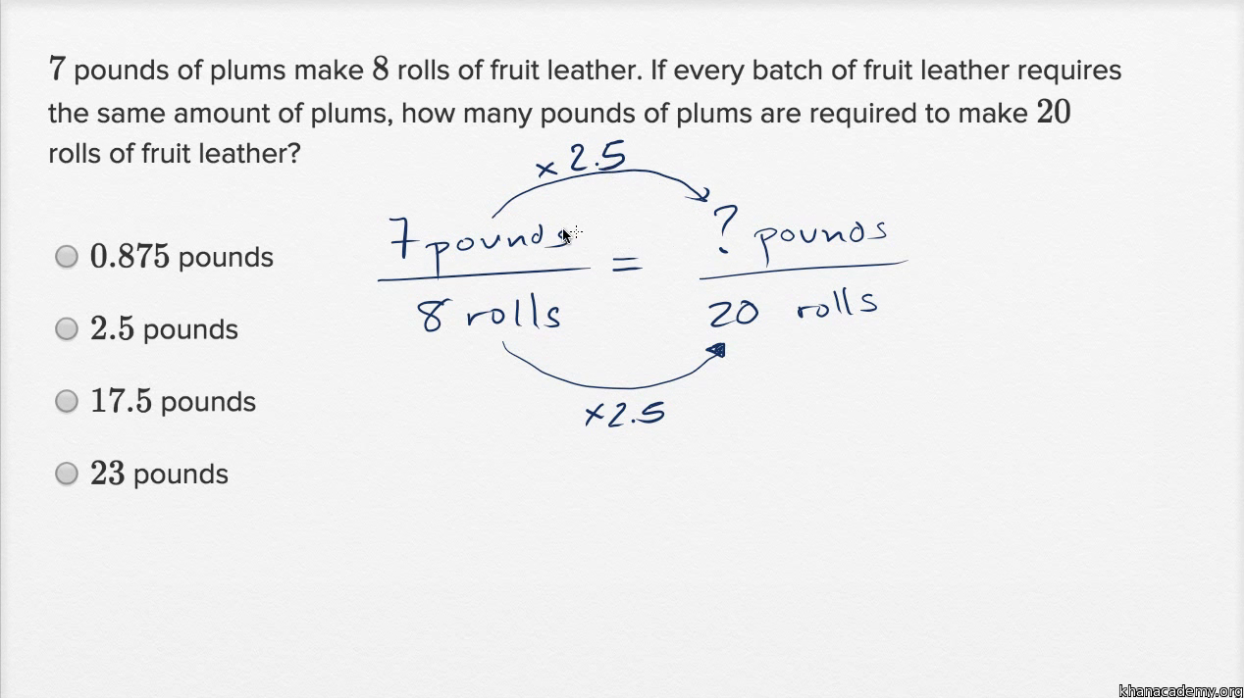
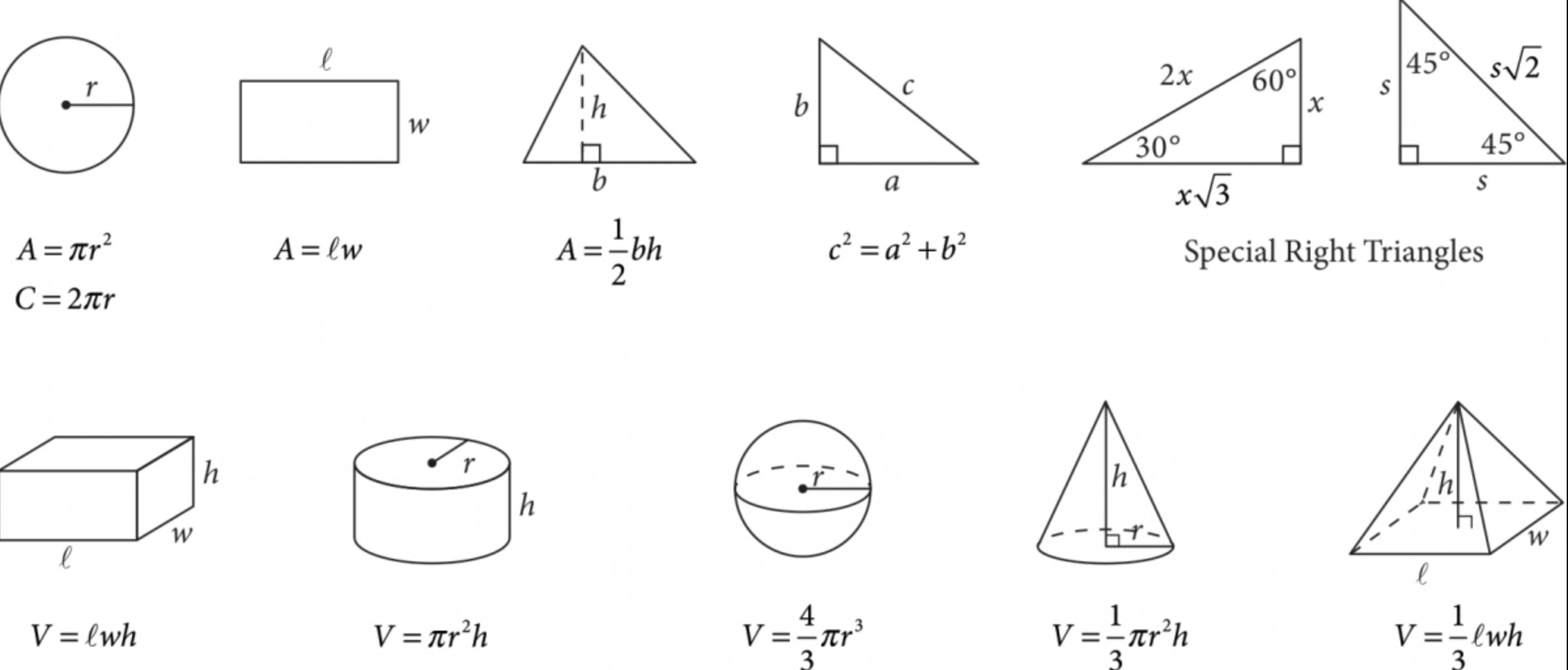
The SAT gives you a reference sheet of formulas that you can pull up on screen at any point during Math, but we still suggest memorizing the common formulas in order to maximize time spent on solving the problems and checking your answers. The following image from the College Board shows some important formulas to remember:
One unique thing about the SAT compared to the ACT is student-produced response questions, better known as grid-ins. They are about 25% of SAT Math, roughly 11 of the 44 questions. Unlike the multiple choice, you can’t really guess on these. You have to come up with an answer to the problem.
ACT Question Types
Like the SAT, the ACT math is also fairly straightforward. Generally, they aren’t as wordy as some SAT math questions. However, as noted earlier, there is a heavier emphasis on geometry and trigonometry on the ACT math than on the SAT math. Also, the ACT math covers a wider range of topics than the SAT math like trigonometry, matrices, and logarithms.
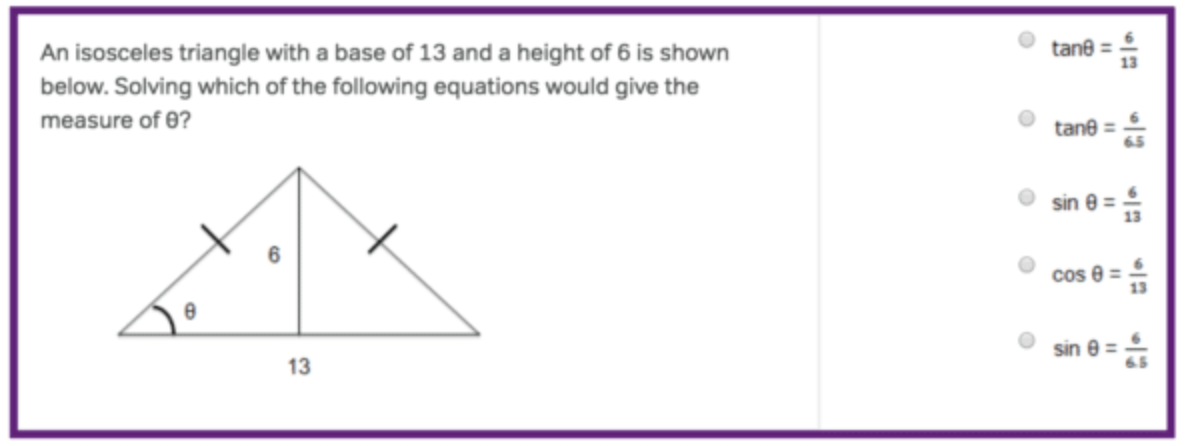
For example:
The following is an example ACT trigonometry problem is from Magoosh.
Unlike the SAT, you will not be given a reference sheet, so you have to memorize all the necessary formulas before test day. That did not change with the shorter ACT.
The trade-off between the SAT and ACT is that the ACT covers a wider range of topics but covers each topic less extensively than the SAT. Topically, if you’re strong in geometry or trigonometry, the ACT might be better suited for you. If you can’t remember formulas and need to rely on given formulas, the SAT might be better suited for you.
Scoring
Imagine this. It’s the fourth quarter. It’s a tied game, and there’s one second left on the clock. Your coach calls a play, and the ball gets inbounded to you. What do you do? You chuck it up. Really. What’s there to lose? You miss, and you might get chirped a little bit, but if you hit, you’ll be the hero.
This analogy may seem weird, but it is an applicable testing strategy to maximize your score in both the SAT and the ACT. Both the SAT and the ACT combine the correct and incorrect answers to give you a raw score which is then converted into a scaled score. This section in this guide will break down the scoring processes of both the SAT and the ACT.
SAT Scoring
As explained earlier, the SAT Math section is broken down into multiple-choice questions and grid-in questions. For each question, you will receive the following on your raw score:
– +1 for each correct answer
– +0 for each incorrect answer
Note: there is no penalty for incorrect or blank answers on the SAT. That’s why on the multiple-choice questions, when the shot clock is running down and you’re unsure about a question, you should just chuck it up and guess one of the answers. Hitting on one of these guesses won’t make you a hero but at least you’ll get a higher SAT score!
The total raw score on the SAT Math section converts to a scaled score between 200-800. With the scaled scores, you don’t have to get every question right in order to achieve a perfect score on the math section. They’re scaled. The scaled score will then give you your percentile ranking which is basically how you stack-up compared to the rest of the people that took the SAT.
For example, if you scored in the 50th percentile, you’re dead on average: you scored better than 50% of all people who took the SAT and 50% scored higher than you.
Fun fact: For each multiple choice question guess, you’re getting 0.25 points added to your raw score (the points are not actually added to your raw score) so for every 4 multiple choice questions that you guess, on average, you’re getting 1 point added to your raw score!
Note: A good test taking strategy is to cross out answers you know are incorrect. If you cross out an incorrect answer, those guesses discussed above result in even more “points” added to your raw score!
ACT Scoring
Every question on the ACT Math section is multiple-choice with four different answer choices. (It was five until the test was shortened in 2025.) For each question on the ACT, you will earn the following on your raw score:
- +1 raw point for each correct answer
- +0 raw point for each incorrect answer
Note: Like the SAT, there is no penalty for incorrect or blank answers on the ACT so the same guessing strategy for questions you’re unsure of as mentioned earlier applies here too. And now that ACT Math has four answer choices rather than five, blind guessing is worth the same on both tests: a 1-in-4 shot.
The total raw score on the ACT converts to a scaled score out of 36. Your Math scaled score is one of the three that get averaged into your composite, along with English and Reading. Science no longer counts toward the composite; if you take it, it is reported on its own and also combines with Math into a STEM score. Like the SAT, you don’t have to get every question right in order to achieve a perfect score. The score is scaled. The scaled score will then give you your percentile ranking which is how you stack-up against everyone else that took the ACT.
SAT Scores and Percentiles vs. ACT Scores and Percentiles
Because scores are scaled, you do not have to get every answer correct to hit a high score, and the percentile you land in is not the same as the percentage of questions you got right.
What we will not do here is hand you a raw-score conversion chart. Those charts get passed around a lot and they are close to useless, for two reasons. First, every test form scales differently. A raw 39 is not a fixed scaled score; it depends on how hard that particular form was. Second, both tests have been redesigned since most of those charts were written, so the raw-score totals they are built on no longer exist. SAT Math is 44 questions now, not 58, and ACT Math is 45, not 60.
The honest version is this: take an official full-length practice test, score it with the conversion table that comes with that specific test, and use the result as your baseline. College Board publishes full practice tests inside Bluebook, and ACT publishes official practice material for the shorter format. Those are the only conversions that will tell you anything real.
For rough orientation while you plan, the SAT total average sits around 1050 and the ACT composite average sits around 19 to 20. Scoring above those puts you in the top half of test-takers. Anything more precise than that has to come from an official practice test.
Summary
The SAT Math:
- Two adaptive modules of 22 questions, 35 minutes each, 44 questions in 70 minutes total
- Comes after both Reading and Writing modules, so it is the second half of the test
- About 95 seconds per question
- Module 1 decides whether module 2 is the harder or easier version, which sets your score ceiling
- Calculator allowed on every question, with Desmos built into Bluebook
- Wrong answers aren’t penalized (guess!)
- Multiple-choice questions with 4 answer choices, plus grid-ins (about 25% of the section) where you type your own answer
- Reference sheet of formulas available on screen throughout Math
- Heavy emphasis on algebra, lighter on geometry and trigonometry
- More emphasis on word problems and data analysis than the ACT
The ACT Math:
- Appears second, right after the English section
- 45 questions, 50 minutes (about 67 seconds per question)
- Not adaptive. Everyone sees the same questions.
- Calculator allowed through the whole section
- Only multiple-choice, with 4 answer choices since the 2025 redesign
- Wrong answers aren’t penalized (guess!)
- No formulas provided
- Larger emphasis on geometry and trigonometry
- Wider range of topics covered than the SAT, but each topic covered less extensively
- Counts toward your composite along with English and Reading, and pairs with Science for a STEM score if you take Science
So Which One Should I Take?
Ultimately, the test you should take comes down to which test suits your strengths. Each test has its own pros and cons for each specific person. If unsure, we recommend taking at least one practice SAT and ACT practice test and comparing your scores. I know. What was the point of reading this guide then? At the end of the day planning can only get you so far, and the results from your practice is the only thing that can give you definitive results. If one score is drastically higher than the other, there you go.
However, that’s not to say that just because you score higher in one math section than the other, that’s your test. What matters is total score so even if you score lower on the SAT math than the ACT math, as long as your SAT overall score is higher, then the SAT is the better option for you.
Standardized testing is all about balance, from balancing your time while taking the test to answer the most amount of questions correctly to finding which test holistically best suits you. Just because you’re strong on one area, doesn’t mean you’ll crush the SAT/ACT.
And even if you don’t achieve the scores you desire, just note that only practice, diligence, and preparation will help you crush the SAT/ACT and achieve your testing potential. For more in-depth teaching about the SAT/ACT, check out our website Prepmedians to learn more about everything you need to know!