Tag: ACT

  • SAT vs ACT: Which One Should You Take?

    SAT vs ACT: Which One Should You Take?

    SAT or ACT?

    Parents and students start the college process by comparing the SAT and ACT tests. The SAT and ACT cover generally the same topics, and both scores are used for college admissions decisions and the awarding of merit based scholarships.

    In the past, schools on the coasts generally gravitated towards the SAT while those in the midwest preferred the ACT. Now, however, the college application landscape has changed and schools have become increasingly flexible; both tests are now widely accepted across all US colleges.

    Don’t let the question of SAT or ACT keep you up at night! Know the basics about each test, your strengths and weaknesses as a test taker, and focus on!

    Comparing the SAT and ACT:

    ACT includes a Science section, the SAT does not.

    SAT includes one SAT Math Section where you may not use a calculator.

    Aspect SAT ACT
    Why Take It Colleges use SAT scores for admissions and merit-based scholarships. Colleges use ACT scores for admissions and merit-based scholarships.
    Test Structure Reading, Writing & Language, Math, Essay (Optional) English, Math, Reading, Science Reasoning, Essay (Optional)
    Length 3 hours (without essay) / 3 hours, 50 minutes (with essay) 2 hours, 55 minutes (without essay) / 3 hours, 40 minutes (with essay)
    Reading 5 reading passages 4 reading passages
    Science None 1 science section testing your critical thinking skills (not your specific science knowledge)
    Math Arithmetic, Algebra I & II, Geometry, Trigonometry and Data Analysis Arithmetic, Algebra I & II, Geometry, Trigonometry, and Probability & Statistics
    Calculator Policy Some math questions don’t allow you to use a calculator. You can use a calculator on all math questions.
    Essays Optional. The essay will test your comprehension of a source text. Optional. The essay will test how well you evaluate and analyze complex issues.
    How It’s Scored Scored on a scale of 400–1600 Scored on a scale of 1–36

    from the Princeton Review

    Here’s an interesting analogy comparing the two tests:

    The ACT is like lifting a 5 pound weight ten times while the SAT feels like lifting 25 pound weights twice. Both are quite draining, but in different ways. The ACT is extremely fast paced while the SAT requires you to think more and deeply.

    Important note: Be sure to look carefully at admission preferences and requirements to double check which of the tests your prospective college accepts.

    According to the College Board, while both tests measure what you learned in high school, the SAT is a better indicator of skills you will actually need to succeed in college and beyond. Instead of focusing on how well you can recall information, the SAT emphasizes one’s ability to apply it in real world scenarios. This is why the SAT provides everyday math formulas while the ACT expects you to memorize them.

    Test Format

    Structure and Timing SAT ACT
    Testing time 3 hours + 50 minute essay (optional) 2 hours 55 minutes + 40 minute essay (optional)
    Structure 3 tests + optional essay 4 tests + optional writing test
    Number of questions 154 215
    Number of breaks 3 2
    Time per question 1 minute, 10 seconds 49 seconds
    Score range Composite 400–1600 (SAT Essay: reported in 3 dimensions, each 2–8) Composite 1–36 (writing domain scores: 2–12)
    Test length and timing Reading Test: 65 minutes, 52 questions. Writing and Language Test: 35 minutes, 44 questions. Math Test: 80 minutes, 58 questions Reading Test: 35 minutes, 40 questions. English Test: 45 minutes, 75 questions. Math Test: 60 minutes, 60 questions. Science Test: 35 minutes, 40 questions

    from the College Board

    Test Timing

    With the SAT having a total of 154 multiple choice questions and the ACT having 215, timing is one of the most important aspects to consider when deciding between which test to take. Based on individual time windows, you have around 1 minute and 10 seconds per question on the SAT and 49 seconds per question on the ACT.

    A little bit stressed out?

    I feel you. Test taking is honestly one of the worst things about the college process in my experience. We love spending summertime huddled over practice tests and test prep books and watching everybody else have fun. Are you feeling this FOMO? Do you find yourself “reading” through grammar rules only to realize that you’ve actually just been looking at the words and not processing anything? It happens to the best of us. Want to crush the ACT or SAT in the next few weeks? We got you. Prepmedians teaches ACT and SAT test prep through entertaining and engaging ways with sketch comedy, music, rap, and more. We’ll get you through those boring summer study days in no time. Check us out today!

  • The Night Before the ACT/SAT

    The Night Before the ACT/SAT

    Review your toughest subject

    Choose the section that you have struggled the most with throughout the test prep process and do a quick review. It could be anything from reviewing a math concept you have struggled with, glancing over grammar rules or looking over a reading passage. Whatever the quick review is, the purpose is not to teach you a brand-new concept, but rather for you to know that you have done everything you could to prepare for the test and to walk into your test the next day feeling confident.

    Eat a good dinner

    Don’t forget to eat a tasty and filling meal the night before for dinner! Maybe your favorite meal (because is there anything else that makes someone feel good before a big day?) But avoid eating anything that is too greasy to make sure you don’t end up with an upset stomach. The last thing you need is your stomach rumbling during the math section because of those chili cheese fries. For more suggestions on what kind of meal is more ideal, refer to Is your Brain Hungry by Gerrin Alexander. Try to eat at a reasonable time, so the dinner does not interfere with your sleep. Keeping your body in good condition is a vital part of being prepared for anything—including test day!

    Pack your test materials

    Checklist for the test day:
    – admission ticket to the test
    – a photo ID (check the test website for what forms of ID are acceptable—generally, a valid driver’s license or a current school ID will be fine)
    – at least two #2 pencils
    – test acceptable calculator (check the test website to know what types are acceptable)
    The night before the test day, be sure to pack all the test materials that you need for the test day. You may also want to pack a healthy snack and bottled drink for the break, to keep your energy for the second half of the test. When choosing a snack, avoid anything too sweet or too salty because it will make you thirsty during the test. A healthy suggestion would be granola bars of some kind to provide you with energy since they are high in protein. Packing all the materials you need for the test the night before would save you the panic of finding everything you need moments before the test!

    Time to relax

    After packing the necessary things, don’t forget to spend some time relaxing. It can be anything from watching a favorite movie, listening to music, unwinding with a video game, or even just spending time with someone. You should probably try not to do anything physically taxing like sports because you don’t want to tire yourself out. Make sure you’re spending your evening doing something you enjoy. The important thing is to feel happy and relaxed. You’ve worked hard preparing for the test, and your mind and body need time to “recharge” before the test. While a good night’s sleep can restore your energy, free time doing something not only restful, but that makes you happy, is important to get you into the right mindset the day before the test.

    We recommend going through our 3.5 minute positive psychology exercise, which you can listen to here. This exercise will help you visualize the testing situation so that you can destress before you even get to the room.

    Get a good night’s sleep

    I am sure you have gotten this advice in all forms before. But what can you do? It is true. Scientific studies have shown how important a good night’s sleep is for improved brain functioning. Using your mind burns more calories than any form of exercise, so taking the test will have the same effect on your energy as spending the morning doing intense workouts. No wonder you need a good night’s sleep! Keep an alarm before going to sleep because the test would be early in the morning and you need to be at the testing center on time. Try to get at least eight hours of sleep, that’s the minimum recommended for adolescents, although nine or ten hours are fine as well. This might mean going to sleep earlier than you usually do, especially for a Friday night, but being well rested on test day is more than worth it!

    The morning of…

    The morning of the test, be sure to get up with enough time to eat some breakfast and get to the testing site with at least fifteen minutes to spare. A good night’s preparation, relaxation, and rest should have you feeling calm and confident for the test itself—you’ve got this!

  • Common Myths About ACT/SAT

    Common Myths About ACT/SAT

    Myth 1:

    The SAT is more accepted among colleges than ACT.

    NO! A common myth is that top-tier schools tend to prefer SAT over ACT. But in reality, all schools accept and look at ACT and SAT in the same scale. The preference of students to take SAT or ACT tends to rely on students’ resident states. The ACT is more popular in the Midwest than the SAT, considering many states in the Midwest require mandatory ACT testing. Students from the West or the East coast tend to prefer the SAT over the ACT. So, the difference in proportion of ACT and SAT scores among the accepted pool in top-tier schools is caused more by the personal preference of students rather than by the preference of colleges.

    Myth 2:

    The October and December ACT/SATs are harder because more seniors tend to take them last minute.

    NO! There were comparative studies done about the average scores from one testing month to another and October had a lower average than May. Thus, the rumors about easier testing dates started running wild. But these testing dates keep changing. Sometimes it’s December with the lowest average and sometimes it’s June. Any student might find one test slightly easier than the other. One section or even one question could seem easier. But that opinion is different for every student. So, don’t pick a date based on this myth. Instead, pick a date that best works with your schedule.

    Myth 3:

    ACT is only for people who have a good science background.

    NO! The ACT Science section tests your ability to read and analyze passages, charts, tables, and graphs. It is not trying to test your in-depth knowledge and understanding of all areas of science. While it does present passages and experiments of science fields like biology, chemistry and others, it is your reasoning and reading comprehension skills that will actually help you in this section (not your hard science knowledge!).
    P.S. The SAT tests your ability to analyze data and graphs too. It does so in a more hidden way by mixing it with other sections.

    Myth 4:

    The ACT is “easier” than the SAT.

    NO! The ACT is not necessarily easier, it’s just that the questions tend to be more straightforward. Students who take the SAT and the ACT with an equal amount of preparation for both tend to score equivalently on both. The SAT has a no-calculator section unlike the ACT. Most students, however, realize that the calculator is not really necessary even for the SAT section that does allow it. It is worth exploring both tests to see which one is better for you! You can prepare for both at Prepmedians.

    Myth 5:

    You have to spend a lot of money to do well on the ACT/SAT.

    NO! Sure, there are many test prep courses require you to spend a lot of money, sometimes even many thousands of dollars. And the cost is often positively correlated with the amount of time you spend. But it’s important to note that the ACT/SAT tests your knowledge gained from all your K-12 education. Most of the topics these tests focus on, like algebra, tend to be from earlier stages of schooling than later. So, none of the topics tested by ACT/SAT are completely new. Rather, they try to gauge how well you understand the fundamental topics. It is not worth paying someone thousands of dollars to have them reteach the content that you already know and waste hundreds of hours of valuable time in that process. Rather, your focus should be on reviewing the topics and finding strategies that would help you tackle the known but hidden patterns of the test. You will find a faster review of the necessary content and strategies, all taught through entertainment at an affordable price, at Prepmedians!

  • Who’s vs. Whose: What’s the Difference?

    Who’s vs. Whose: What’s the Difference?

    Definitions

    To start out, let’s first define who’s and whose:
    who’sa contraction for “who is” or “who has”
    whosea possessive pronoun meaning belonging to or associated with which person

    Roots: Who and Whom

    To understand when to use each word, one must first start from the basics: the root. The pronouns used as the roots of “who’s” and “whose” are “who” and “whom.”

    “Who” and “whom” are similar in that you’ll use both when describing a person or when asking a question about which person did something. The difference between “who” and “whom” is that “who” is a subject pronoun so it will be the subject of a clause or phrase and “whom” is an object pronoun. Some other examples of subject pronouns are he/she/they, and some other examples of object pronouns are him/her/them.

    For more help in the difference between “who” and “whom,” check out our website Prepmedians to learn more about proper usage between the two.

    “Who” Examples:

    • Who called my phone?
    • Who asked you to prom?
    • Jed, who is a musician, only talks about being a musician.

    “Whom” Examples:

    • Whom does Hannah B. love?
    • Whom do you believe?
    • Do you know with whom you will go to prom?

    Usage and Examples

    Who’s

    “Who’s” is a contraction of either “who+is” or “who+has.” The apostrophe in the contraction of who’s stands for the missing letters of either “i” in who is or “ha” in who has.

    Examples:
    – Who’s on right now? (Who is on right now?)
    – Who’s your one true love? (Who is your one true love?)
    – Who’s gone outside of the country? (Who has gone outside of the country?)

    Whose

    Whose is a possessive pronoun used in questions when asking about ownership of one thing.

    Examples:
    – Whose side are you on?
    – Whose phone are you calling?
    – Whose song are you listening to?

    By the way, “Whose mans is that?” does use the proper “whose”! Also, if you’re concerned about getting to a level where someone says that about you, we can help get you there on the grammar end, but you’ll probably want to look to an actual dating coach like our friend Blaine Anderson.

    #1 Tip for Remembering the Difference

    It’s helpful and all to remember the definitions of “whose” and “who’s,” but proper usage can still elude even those who memorized the definitions. Here are 2 tips for remembering which one to correctly use:

    Plug in “who is” or “who has”

    One easy way for proper usage is to replace “who’s” or “whose” with “who is” or “who has.” Think of our first examples. Whose mans is this? and Who’s Hannah going to give a rose to on the next week of the Bachelorette? Now replace both “whose” and “who’s” with “who is” or “who has” and see if it makes sense.

    Who is man is this? No, that doesn’t seem right. It sounds too clunky so “whose” is probably the right choice.
    Whom is Hannah going to give a rose to on the next week of the Bachelorette? Yep, seems right. “Who’s” is the correct choice here.

    Key Takeaways:

    • “Who’s” is a contraction of “who is” or “who “has.”
    • Whose is a possessive pronoun and another way of saying “belonging to whom”.
    • Plug in “who is” or “who has” in the blank; if either works, then “who’s” is the correct answer.

    For more help on homophones, tricky pronouns, or any other material you might encounter on the SAT/ACT, check out our website Prepmedians to learn more about everything you need to know!

  • SAT Math vs. ACT Math: The Ins and the Outs

    SAT Math vs. ACT Math: The Ins and the Outs

    What’s in this guide?

    Which is easier? Which is faster? Which one am I more likely to score higher in?

    This guide will help pilot you in your search for which test to take, but ultimately, it comes down to which math section is right for you?

    In this guide, we’re going to break down the similarities and the differences between the SAT Math section and the ACT math section and help you decide which standardized test best suits you.

    Organization

    Before diving into the specifics, let’s first look at each math section from an aerial view and see how it’s structured.

    SAT Math Organization

    The SAT has three main sections (four with the SAT essay section) that will always appear in the same order. The test will take three hours (three hours and 50 minutes with the essay), and the math section takes up 80 minutes (about half the test without the essay), excluding break times. Once the math section is over, you won’t be able to go back and answer any missed questions or check back on any questions you were unsure about. Time management is key.

    Here’s an overview of the SAT Math section:

    SAT Math Section Order of Appearance on Test # of Questions Total Time Time per Question
    No Calculator 3 (after writing) 20 25 minutes 75 seconds
    Calculator 4 38 55 minutes 87 seconds

    Note: The Time per Question part above is only a general guideline on the amount of time you should spend per question. On average, you’ll spend 75 seconds per question on the no calculator section and 87 seconds per question on the calculator section but feel free to allot more time on some questions than others.

    The SAT Math section is the only section on the SAT that’s divided into two segments: a No Calculator section (no use of calculator) and a Calculator section (able to use a calculator). In between the two sections, there is a short 5 minute break. The No Calculator section appears first right after the Writing section and is 25 minutes long. The Calculator section appears right after the No Calculator section and is 55 minutes long.

    Generally, people who are more confident in their mathematical abilities lean towards the SAT over the ACT since they aren’t as reliant on their calculator. In addition, you get more time per question with the SAT math section than you get with the ACT math section so you get more time to solve the problems and check your answers (we’ll touch on this later in this guide).

    ACT Math Organization

    The ACT has four main sections (five with the ACT essay section) that, like the SAT, will always appear in the same order. The test will take 2 hours and 55 minutes (three hours and 35 minutes with the essay), excluding break times. Like the SAT, once the math section is over, you won’t be able to go back and answer any missed questions or check back on any questions you were unsure about. Time management is key.

    Here’s an overview of the ACT Math section:

    ACT Section Order of Appearance # of Questions Total Time Time Per Question
    Math 2 (after English) 60 60 minutes 1 minute

    Note: The Time per Question part above is only a general guideline on the amount of time you should spend per question. On average, you’ll spend 1 minute or 60 seconds per question on the ACT math section.

    The ACT Math section always appears right after the ACT English section and right before the ACT Reading section (appears second). Generally, people who like to grind things out in one sitting lean towards the ACT over the SAT since the ACT math section is 60 consecutive minutes – no break in between.

    Design-wise, everyone has their own preferences so the “better” test design is the one that best works for you. If you can’t do math without a calculator, the ACT is better for you. If you’d like more time per question to solve problems and check your work, the SAT is better for you.

    Question Types

    Although many of the topics covered in the SAT Math section and ACT Math section are similar, the way they are presented are drastically different. The following section will hopefully provide clarity on what to expect in the math sections when taking the SAT or ACT

    SAT Question Types

    The SAT math section is fairly straightforward that cover a broad range of topics, specifically focusing on algebra.
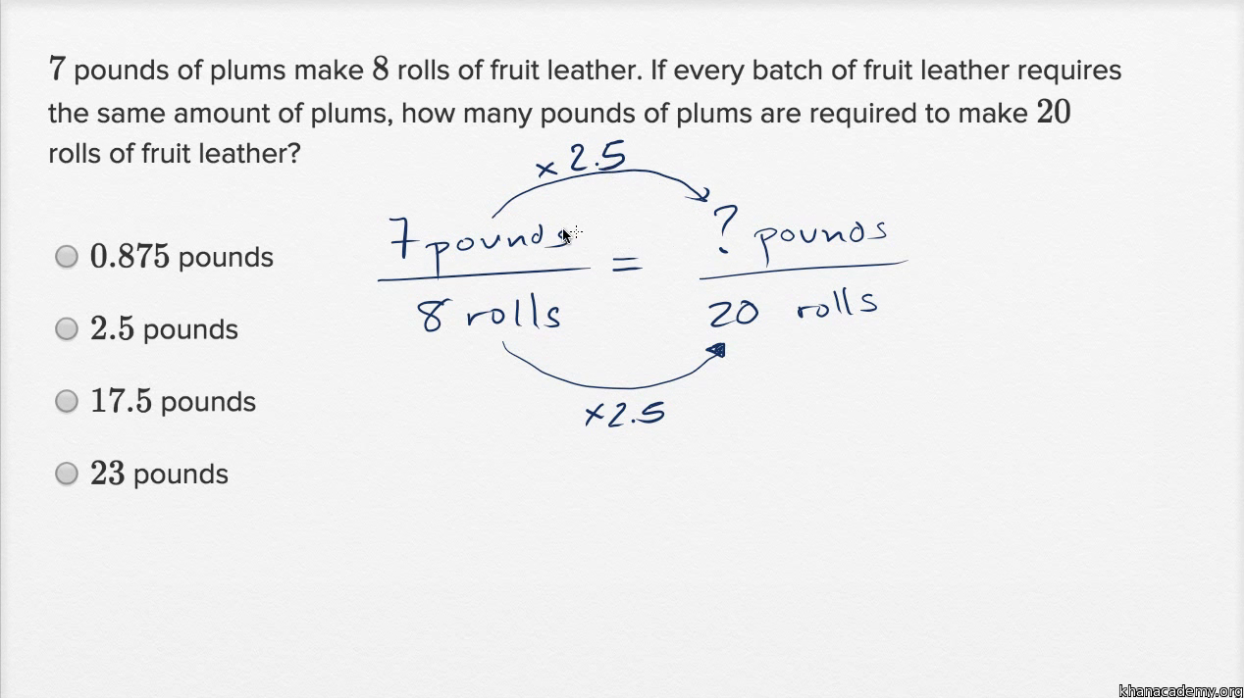
    In general, the SAT math tests fewer concepts/topics than the ACT math, specifically, less than 10% of SAT questions are on geometry and the SAT has fewer trigonometry questions than the ACT. However, the SAT math does have an emphasis on word problems and data analysis. Many parts of the SAT math include several questions off of one scenario.

    For example:
    The following is an example SAT algebra problem is from Khan Academy.
    Screen Shot 2019-07-08 at 2.12.27 PM

    The SAT will always give you a formula box at the beginning of the Calculator and No Calculator section, but we still suggest memorizing certain formulas in order to maximize time spent on solving the problems and checking your answers. The following image from the College Board shows some important formulas to remember:
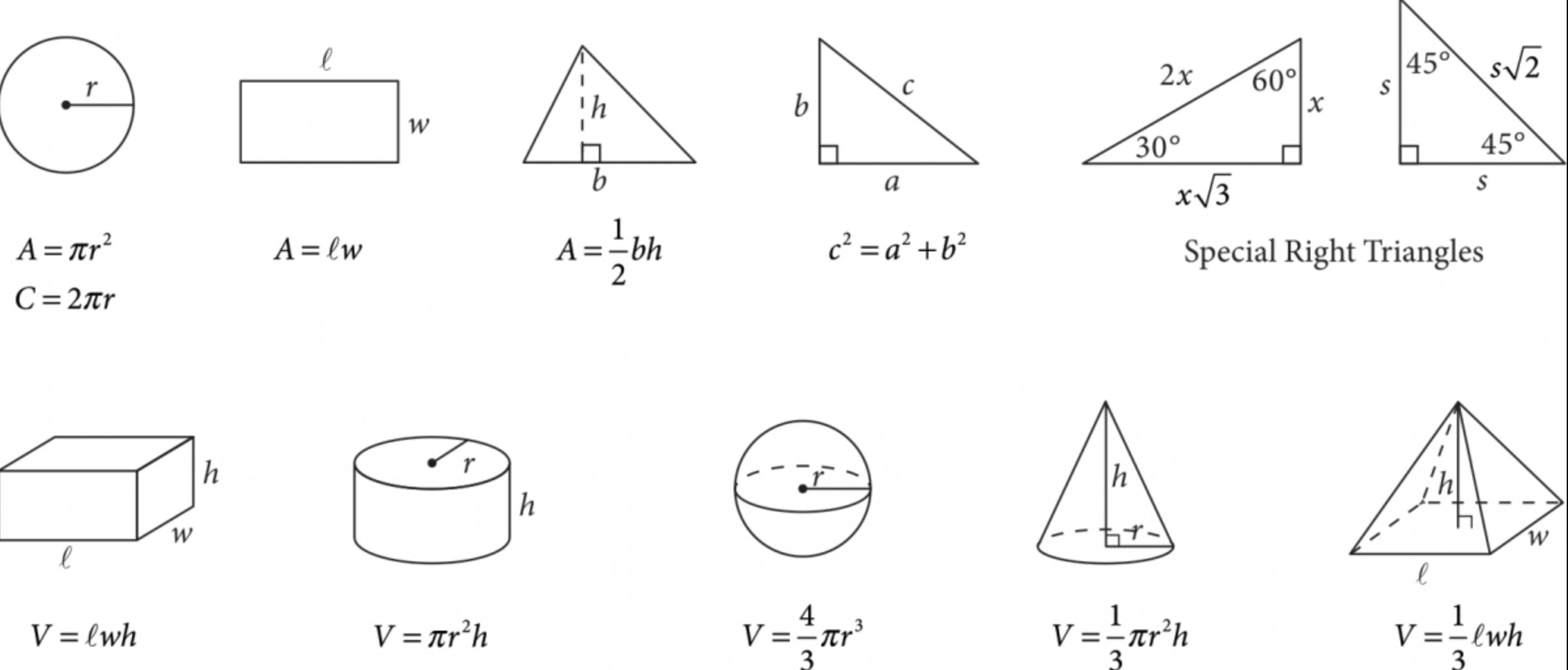
    Screen Shot 2019-07-08 at 2.15.32 PM

    One unique thing about the SAT compared to the ACT is that there are 13 grid-in questions which is about 22% of the SAT math section. Unlike the multiple choice, you can’t really guess on these. You have to come up with an answer to the problem.

    ACT Question Types

    Like the SAT, the ACT math is also fairly straightforward. Generally, they aren’t as wordy as some SAT math questions. However, as noted earlier, there is a heavier emphasis on gemoetry (35-40% of questions on ACT Math) and trigonometry on the ACT math than the SAT math. Also, the ACT math covers a wider range of topics than the SAT math like trigonometry, matrices, and logarithms.

    For example:
    The following is an example ACT trigonometry problem is from Magoosh.
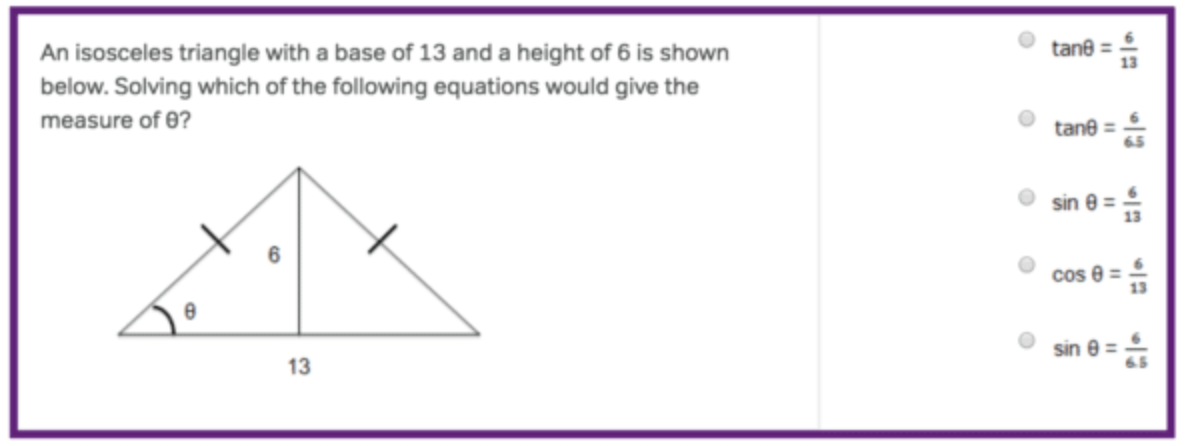
    Screen Shot 2019-07-08 at 2.22.56 PM

    Unlike the SAT, you will not be given a formula box so you have to memorize all the necessary formulas before the test day.

    The trade-off between the SAT and ACT is that the ACT covers a wider range of topics but covers each topic less extensively than the SAT. Topically, if you’re strong in geometry or trigonometry, the ACT might be better suited for you. If you can’t remember formulas and need to rely on given formulas, the SAT might be better suited for you.

    Scoring

    Imagine this. It’s the fourth quarter. It’s a tied game, and there’s one second left on the clock. Your coach calls a play, and the ball gets inbounded to you. What do you do? You chuck it up. Really. What’s there to lose? You miss, and you might get chirped a little bit, but if you hit, you’ll be the hero.

    This analogy may seem weird, but it is an applicable testing strategy to maximize your score in both the SAT and the ACT. Both the SAT and the ACT combine the correct and incorrect answers to give you a raw score which is then converted into a scaled score. This section in this guide will break down the scoring processes of both the SAT and the ACT.

    SAT Scoring

    As explained earlier, the SAT Math section is broken down into multiple-choice questions and grid-in questions. For each question, you will receive the following on your raw score:
    – +1 for each correct answer
    – +0 for each incorrect answer

    Note: there is no penalty for incorrect or blank answers on the SAT. That’s why on the multiple-choice questions, when the shot clock is running down and you’re unsure about a question, you should just chuck it up and guess one of the answers. Hitting on one of these guesses won’t make you a hero but at least you’ll get a higher SAT score!

    The total raw score on the SAT Math section converts to a scaled score between 200-800. With the scaled scores, you don’t have to get every question right in order to achieve a perfect score on the math section. They’re scaled. The scaled score will then give you your percentile ranking which is basically how you stack-up compared to the rest of the people that took the SAT.

    For example, if you scored in the 50th percentile, you’re dead on average: you scored better than 50% of all people who took the SAT and 50% scored higher than you.

    Fun fact: For each multiple choice question guess, you’re getting 0.25 points added to your raw score (the points are not actually added to your raw score) so for every 4 multiple choice questions that you guess, on average, you’re getting 1 point added to your raw score!

    Note: A good test taking strategy is to cross out answers you know are incorrect. If you cross out an incorrect answer, those guesses discussed above result in even more “points” added to your raw score!

    ACT Scoring

    Every question on the ACT Math section is multiple-choice with five different answer choices. For each question on the ACT, you will earn the following on your raw score:

    • +1 raw point for each correct answer
    • +0 raw point for each incorrect answer

    Note: Like the SAT, there is no penalty for incorrect or blank answers on the ACT so the same guessing strategy for questions you’re unsure of as mentioned earlier applies here too. However, since the ACT has 5 answer choices rather than 4, the guessing strategy is less effective.

    The total raw score on the ACT converts to a scaled score out of 36. Like the SAT, you don’t have to get every question right in order to achieve a perfect score. The score is scaled. The scaled score will then give you your percentile ranking which is how you stack-up against everyone else that took the ACT.

    SAT Scores and Percentiles vs. ACT Scores and Percentiles

    As discussed earlier, since the scores are scaled, you don’t have to get every answer correct in order to achieve a perfect score. Like-wise, the perecentile you place in isn’t the exact percentage of questions answer correctly. The following information shows the amount and percentage of questions you must answer correctly on the SAT and ACT math sections to score in certain percentiles. All the data below comes from current SAT and ACT percentiles and official SAT and ACT practice tests.
    SAT:

    SAT Raw Score SAT Scaled Score SAT % Questions Correct SAT Percentiles
    20 450 34% 25th percentile
    28 520 48% 50th percentile
    39 600 67% 75th percentile
    52 730 90% 95th percentile

    ACT:

    | ACT Raw Score | ACT Scaled Score | ACT % Questions Correct | ACT Percentiles |
    | ———- | ———- | ———- | ———- |
    | 16-18 | 16 | 27-30% | 25th percentile |
    | 25-26 | 19 | 42-43% | 50th percentile |
    | 34-36 | 24 | 57-60% | 75th percentile |
    | 49-50 | 30 | 82-83% | 95th percentile |
    Note: Since every SAT/ACT test is unique, these are only general guidelines for the raw score and % questions answered correctly needed to get a certain scaled score and certain percentile. Basically, this means there might be a small range in either positive or negative direction needed to achieve a certain scaled score and percentile.

    As shown in the data above, you need to answer more questions right on the SAT to achieve a certain percentile than the ACT. In general, you would need to answer 2-3 more questions correctly on the SAT to achieve the same percentile on the ACT.

    Summary

    The SAT Math:

    • Divided into two parts: No Calculator and Calculator
    • No Calculator appears third, after Writing and language, Calculator appears fourth, after No Calculator
    • No Calculator: 75 seconds per question, Calculator: 87 seconds per question
    • Wrong answers aren’t penalized (guess!)
    • Consists of multiple-choice questions (4 answer choices) and grid-in questions (give your own answer)
    • Formula box provided in the beginning of both No Calculator and Calculator section
    • Heavy emphasis on algebra, less so on geometry and trigonometry
    • More emphasis on word problems and data analysis than the ACT

    The ACT Math:

    • Appears second, right after the English section
    • 60 questions, 60 minutes (1 minute per question)
    • Calculator allowed through the whole section
    • Only multiple-choice, each multiple-choice having 5 answer choices
    • Wrong answers aren’t penalized (guess!)
    • No formulas provided
    • Larger emphasis on geometry (35-40% of questions)and trigonometry
    • Wider range of topics covered than the SAT, but each topic covered less extensively

    So Which One Should I Take?

    Ultimately, the test you should take comes down to which test suits your strengths. Each test has its own pros and cons for each specific person. If unsure, we recommend taking at least one practice SAT and ACT practice test and comparing your scores. I know. What was the point of reading this guide then? At the end of the day planning can only get you so far, and the results from your practice is the only thing that can give you definitive results. If one score is drastically higher than the other, there you go.

    However, that’s not to say that just because you score higher in one math section than the other, that’s your test. What matters is total score so even if you score lower on the SAT math than the ACT math, as long as your SAT overall score is higher, then the SAT is the better option for you.

    Standardized testing is all about balance, from balancing your time while taking the test to answer the most amount of questions correctly to finding which test holistically best suits you. Just because you’re strong on one area, doesn’t mean you’ll crush the SAT/ACT.

    And even if you don’t achieve the scores you desire, just note that only practice, diligence, and preparation will help you crush the SAT/ACT and achieve your testing potential. For more in-depth teaching about the SAT/ACT, check out our website Prepmedians to learn more about everything you need to know!

  • How is the ACT Scored?

    How is the ACT Scored?

    Overview

    If you’re just starting to prepare for the ACT, you’re probably wondering how the ACT is scored. It’s important to fully understand how the ACT scores their exams in order to get a leg up and prep in a more efficient and effective manner. Below we’ve outlined how the ACT is scored, section by section, with official ACT scoring charts.

    The ACT has four sections: English, Math, Reading, and Science. Each section is given a scaled score between 1 and 36. Your composite score is the average of your four section scores.

    An important note: THERE IS NO POINT DEDUCTION FOR ANSWERING INCORRECTLY ON THE ACT – so NEVER leave a question blank.

    How are raw ACT scores converted into scaled scores?

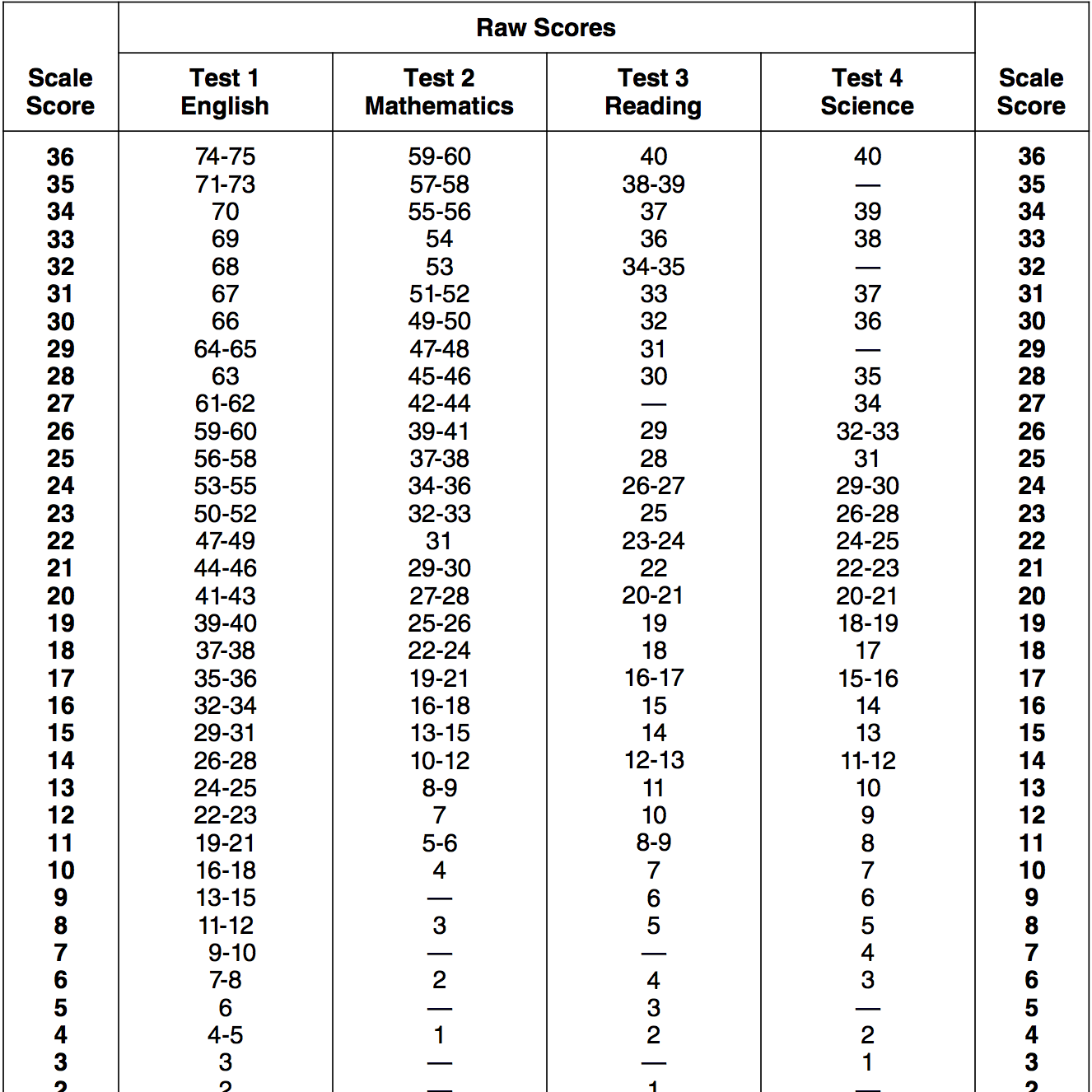
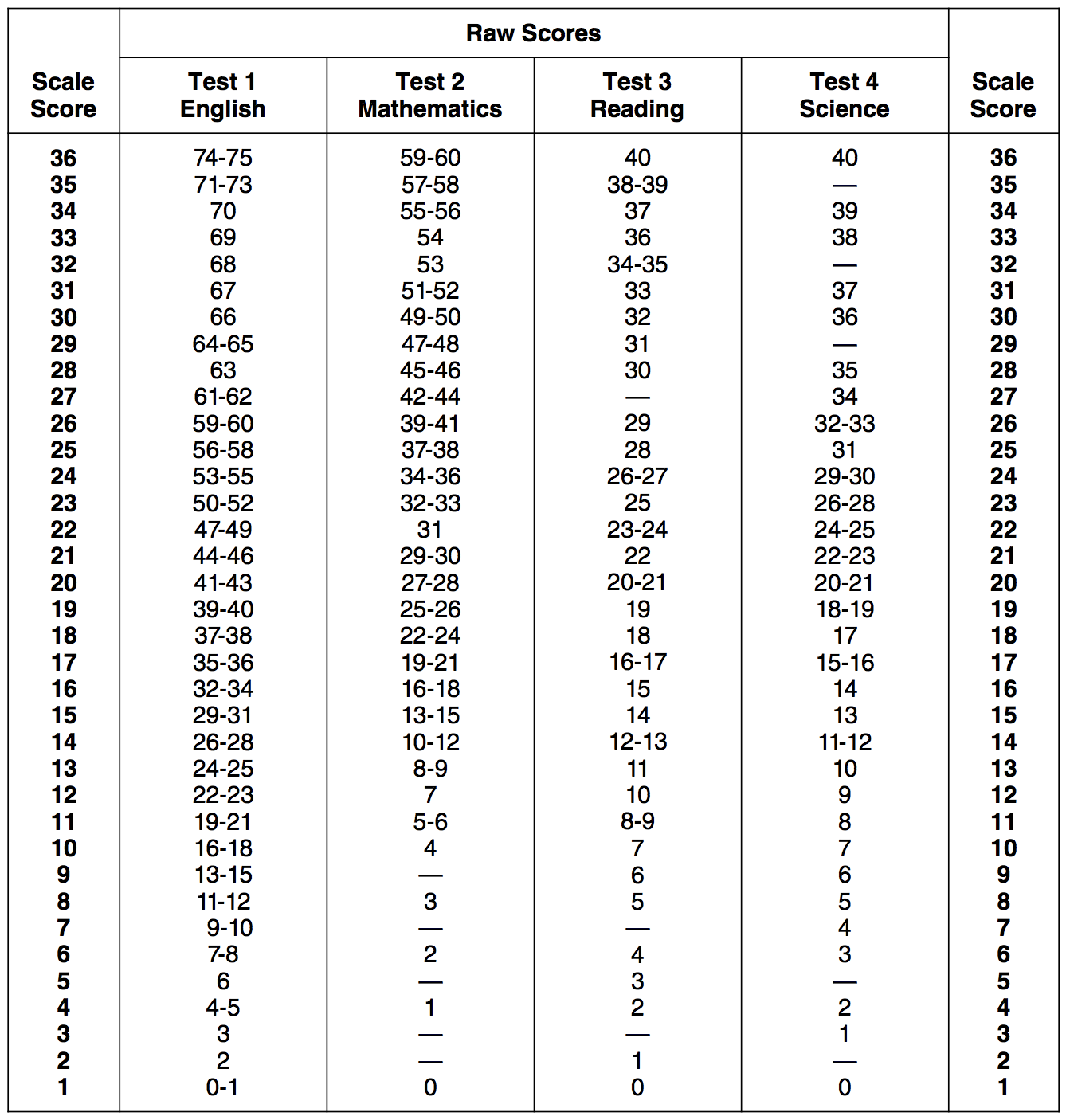
    A raw score is the total number of questions you answer correctly, which is converted into a scaled score between 1 and 36. The ACT scales scores to make sure their scores are consistent across multiple test dates. See below for an example of how the ACT converts raw scores to scaled scores:
    Screen Shot 2019-07-10 at 4.24.33 PM

    How is a composite score calculated?

    We know that each section (English, Math, Reading, Science) receives a scaled score between 1 and 36, but how do these four scores combine to create a composite score? It’s actually quite simple; your composite score is the average of your four section scores, rounded up to the nearest whole number. Half a point or more is rounded up, less than half a point is rounded down.

    For example, if you got a 24 on English, 25 on Math, 23 on Reading, and 26 on Science:
    (24 + 25 + 23 + 26) / 4 = 24.5

    So your composite score would be a 25.

    What are ACT subscores?

    Not only does the ACT provide a composite score and four individual section scores, you will also receive subscores in three of the four subject areas (English, Math, Reading). This will give you some more information about your strengths and weaknesses.

    Subscores are scaled from your raw score, but range from 1 to 18. There is no direct relationship between subscores and final scaled scores. Subscores merely provide more information about your performance and what you might need to improve.

    Do not worry about ACT subscores. Colleges care more about your ACT composite score, and will also look at your individual section scores.

    ACT Section Breakdown

    How many raw points possible are on each section? How are scores calculated?

    English

    The English section on the ACT has 75 multiple choice questions, so the highest raw score one could achieve is a 75. Questions answered incorrectly or left blank are simply not added on to the raw score.

    There are typically 40 Usage/Mechanics questions and 35 Rhetorical Skills questions.

    For example, if you answer 60 questions correctly on the English section, get 10 wrong, and leave 5 blank, your raw score would be 60. Using the ACT’s raw score to scaled score conversion chart above, you would get a scaled score of 26 for the English section.

    Math

    The Math section on the ACT has 60 multiple choice questions. There are typically 24 Pre-Algebra/Elementary Algebra questions and 18 Plane Geometry/Trigonometry questions.

    For example, if you answer 45 questions correctly, with 14 wrong and 1 left blank, your raw score would be 45. From the conversion chart above this would scale to a 27.

    Reading

    The Reading section on the ACT has 40 multiple choice questions. There are typically 20 Social Studies/Natural Sciences questions and 20 Arts/Literature questions.

    Science

    The Science section on the ACT has 40 multiple choice questions. There are three distinct question types: data representation, research summaries, and conflicting viewpoints.

    Here’s a quick plug:

    To all the frustrated juniors, seniors, and parents out there, are you tired of grinding through prep books? I, too, was not blessed with natural ACT test taking skills. To prep, I spent a whole month, every single day for 8 hours, nonstop grinding… that’s a lie. For me, I struggled to stay focused and motivated, and it was a painful and drawn-out process. I remember countless times where I had read through a page of an ACT English prep book, and then realized that I had processed absolutely nothing! Fantastic, time to re-read the page for the 7th time. Nobody wants to read through a list of mind numbing grammar rules. To be blunt, it just straight up sucks. Prepmedians, however, really changes the game. With sketch comedy, rap, music, and more, ACT and SAT test prep is taught in a much more engaging and entertaining way – not to mention the Saturday Night Live level of production (seriously, check it out here). With fundamental concepts and test specific strategies interwoven into each lesson module, you could easily raise your score by 2 points in two weeks. Check us out at Prepmedians.com!

    ACT Writing

    The ACT also offers an additional writing section that occurs after the Science section. The writing section is NOT multiple choice – you will be writing the essay by hand. The essay is evaluated by two graders who score your essay from 1-6 based off of four domains; the highest score you can get per domain is 12. Your Writing score is a number between 2 and 12, calculated from the average of your four domain scores.

    One question asked rather frequently: will the writing score affect my composite score? The answer is no, the composite score solely consists of English, Math, Reading, and Science. People usually take ACT Writing because some colleges require the ACT to be taken with Writing.

  • ACT English Section: What You Need to Know

    ACT English Section: What You Need to Know

    What is in the English section?

    The English section of the ACT tests your knowledge of standard English language conventions, elements of writing, and language. You will have 45 minutes to complete 75 multiple-choice questions. The test contains five passages, each with a set of varied questions that will test your understanding of the mentioned topics.

    How to Prepare?

    One way to know where to start would be to take a practice test to see what categories within the English section are your strengths and weaknesses. You can solidfy your strengths because they tend to be small mistakes that can be easily fixed. Then you can find lessons, like the videos in Prepmedians to learn the weaker topics more thoroughly. Because what tops test prep through comedy and music in Prepmedians? Another way would be to learn all the topics addressed in the test from the easier fundamental grammar rules to the more difficult structure rules. The breakdown of the topics are listed below for reference.

    Grammar:

    Excelling in the grammar rules tested by the ACT is essential in doing well in the ACT English section. ACT tends to test grammar rules repeatedly. These topics are applied by everyone on a day to day life from talking to texting. It would be useful to formally learn these topics through the entertaining videos in Prepmedians. Understanding and learning these topics would allow you to ace the mechanics questions in the English section.

    Grammar/Mechanics topics:

    • Parts of Speech
    • Independent/Dependent Clauses
    • Punctuation
    • Pronouns
    • Verb Tenses and Forms
    • Subject and Verb Agreement
    • Prepositions
    • Comma Rules
    • Wordiness/Redundancy
    • Possessives
    • Parallelism
    • Dangling Modifiers

    Substance and Structure:

    These questions are different from the grammar questions as they test your reading comprehension and your ability to analyze texts. The main strategy to tackle these questions is to be able to identify what the question is asking you to do. This is a step above knowing the English conventions. To be able to excel in these questions, it is necessary to know the strategies you need to know for each type of question. These top scoring strategies to tackle all types of structure and substance question can be found in Prepmedians.

    Substance and Structure Topics:

    • Main Idea
    • Theme
    • Add/Delete
    • Transitions
    • Placement/Relevance
    • Author’s goal/technique

    Takeaways and Tips:

    • The ideal time to spend on each passage would be…9 minutes.
    • Mechanics questions should take approximately 30 seconds.
    • Substance and Structure questions should take approximately 1 minute.
    • Choosing any answer would give you a 25% better chance than not choosing an answer (guess!!).

    Checkout Prepmedians to learn these topics more in depth and get more of these tips and takeaways!