Overview
If you’re just starting to prepare for the ACT, you’re probably wondering how the ACT is scored. It’s important to fully understand how the ACT scores their exams in order to get a leg up and prep in a more efficient and effective manner. Below we’ve outlined how the ACT is scored, section by section, with official ACT scoring charts.
The ACT has four sections: English, Math, Reading, and Science. Each section is given a scaled score between 1 and 36. Your composite score is the average of your four section scores.
An important note: THERE IS NO POINT DEDUCTION FOR ANSWERING INCORRECTLY ON THE ACT – so NEVER leave a question blank.
How are raw ACT scores converted into scaled scores?
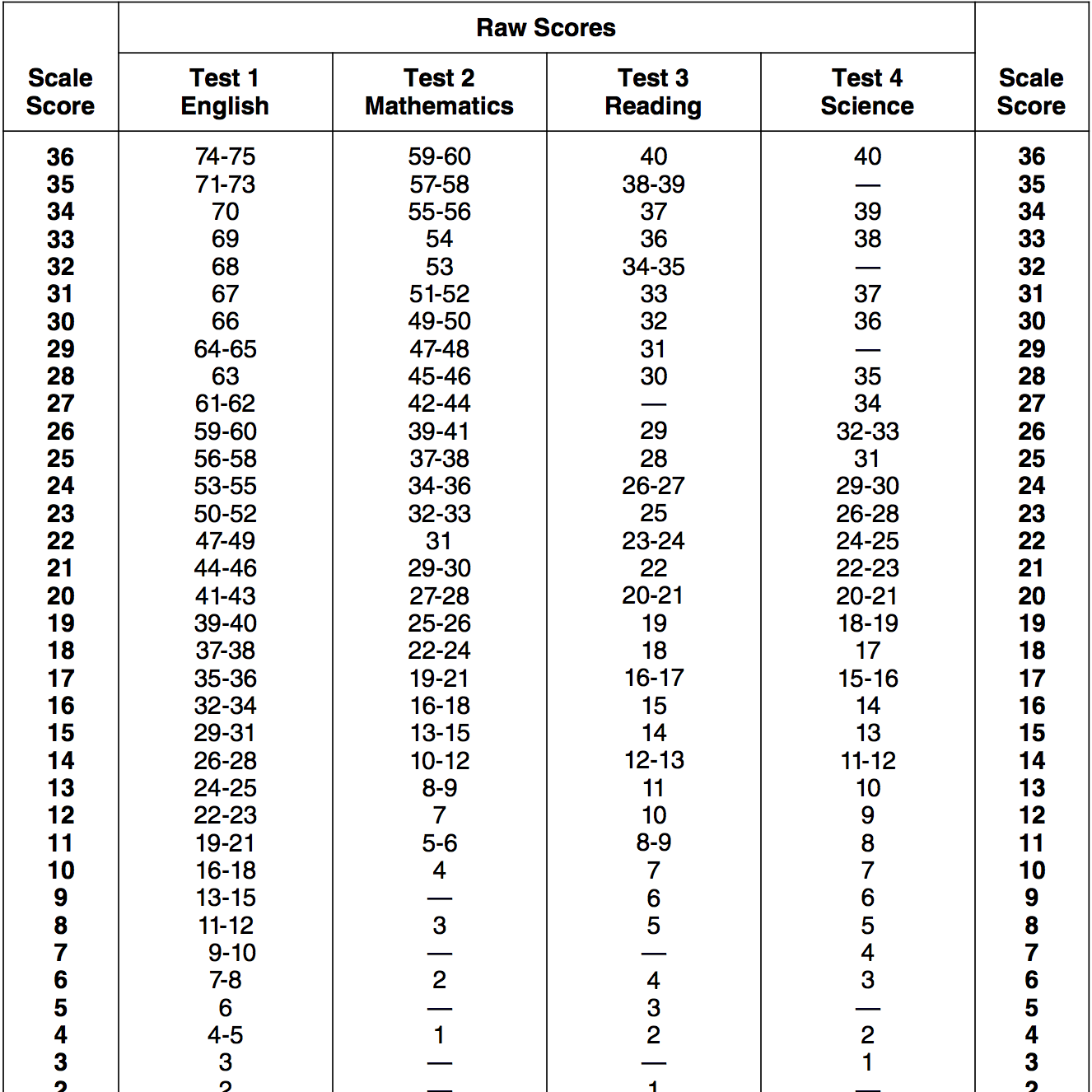
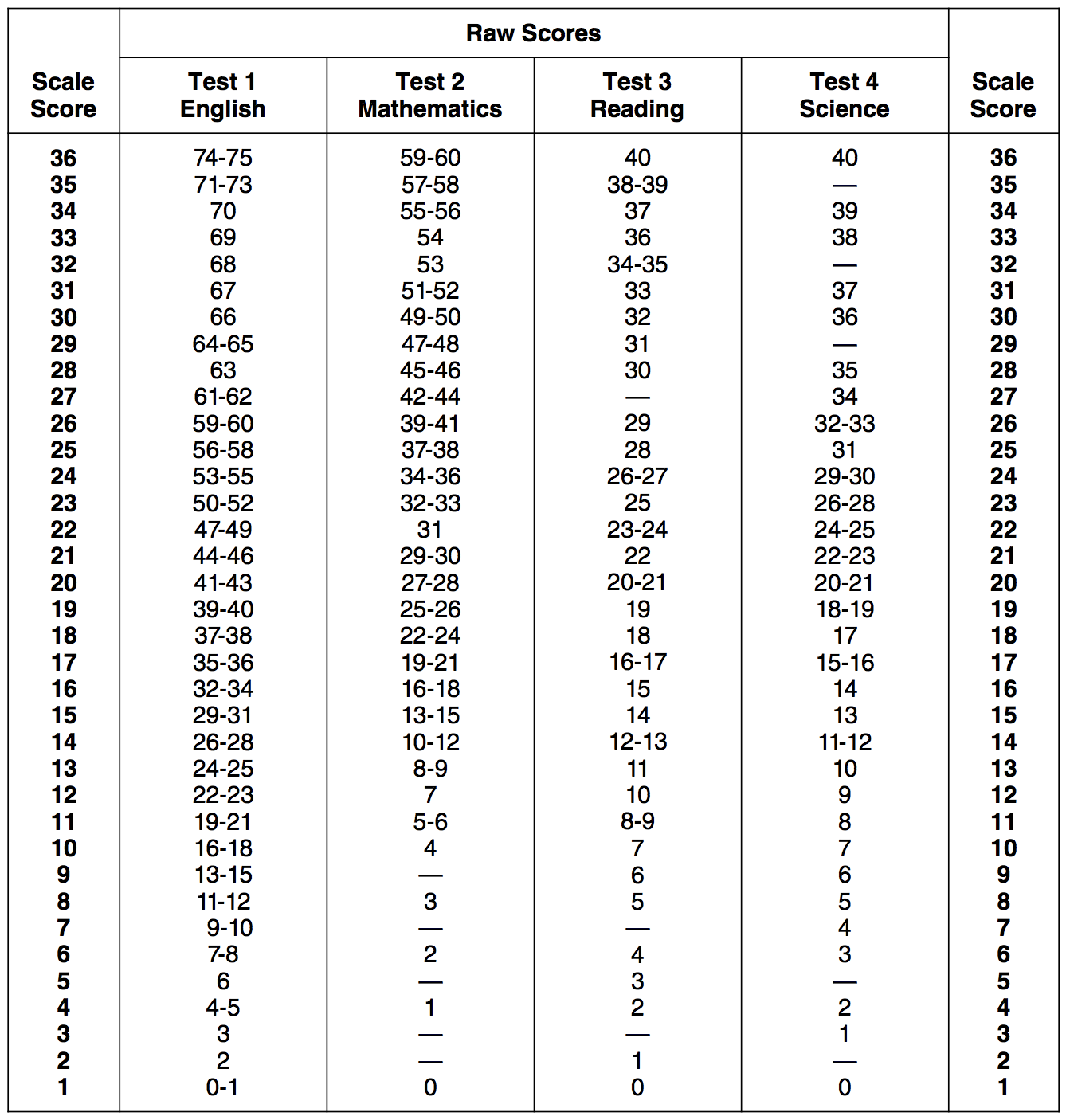
A raw score is the total number of questions you answer correctly, which is converted into a scaled score between 1 and 36. The ACT scales scores to make sure their scores are consistent across multiple test dates. See below for an example of how the ACT converts raw scores to scaled scores:
How is a composite score calculated?
We know that each section (English, Math, Reading, Science) receives a scaled score between 1 and 36, but how do these four scores combine to create a composite score? It’s actually quite simple; your composite score is the average of your four section scores, rounded up to the nearest whole number. Half a point or more is rounded up, less than half a point is rounded down.
For example, if you got a 24 on English, 25 on Math, 23 on Reading, and 26 on Science:
(24 + 25 + 23 + 26) / 4 = 24.5
So your composite score would be a 25.
What are ACT subscores?
Not only does the ACT provide a composite score and four individual section scores, you will also receive subscores in three of the four subject areas (English, Math, Reading). This will give you some more information about your strengths and weaknesses.
Subscores are scaled from your raw score, but range from 1 to 18. There is no direct relationship between subscores and final scaled scores. Subscores merely provide more information about your performance and what you might need to improve.
Do not worry about ACT subscores. Colleges care more about your ACT composite score, and will also look at your individual section scores.
ACT Section Breakdown
How many raw points possible are on each section? How are scores calculated?
English
The English section on the ACT has 75 multiple choice questions, so the highest raw score one could achieve is a 75. Questions answered incorrectly or left blank are simply not added on to the raw score.
There are typically 40 Usage/Mechanics questions and 35 Rhetorical Skills questions.
For example, if you answer 60 questions correctly on the English section, get 10 wrong, and leave 5 blank, your raw score would be 60. Using the ACT’s raw score to scaled score conversion chart above, you would get a scaled score of 26 for the English section.
Math
The Math section on the ACT has 60 multiple choice questions. There are typically 24 Pre-Algebra/Elementary Algebra questions and 18 Plane Geometry/Trigonometry questions.
For example, if you answer 45 questions correctly, with 14 wrong and 1 left blank, your raw score would be 45. From the conversion chart above this would scale to a 27.
Reading
The Reading section on the ACT has 40 multiple choice questions. There are typically 20 Social Studies/Natural Sciences questions and 20 Arts/Literature questions.
Science
The Science section on the ACT has 40 multiple choice questions. There are three distinct question types: data representation, research summaries, and conflicting viewpoints.
Here’s a quick plug:
To all the frustrated juniors, seniors, and parents out there, are you tired of grinding through prep books? I, too, was not blessed with natural ACT test taking skills. To prep, I spent a whole month, every single day for 8 hours, nonstop grinding… that’s a lie. For me, I struggled to stay focused and motivated, and it was a painful and drawn-out process. I remember countless times where I had read through a page of an ACT English prep book, and then realized that I had processed absolutely nothing! Fantastic, time to re-read the page for the 7th time. Nobody wants to read through a list of mind numbing grammar rules. To be blunt, it just straight up sucks. Prepmedians, however, really changes the game. With sketch comedy, rap, music, and more, ACT and SAT test prep is taught in a much more engaging and entertaining way – not to mention the Saturday Night Live level of production (seriously, check it out here). With fundamental concepts and test specific strategies interwoven into each lesson module, you could easily raise your score by 2 points in two weeks. Check us out at Prepmedians.com!
ACT Writing
The ACT also offers an additional writing section that occurs after the Science section. The writing section is NOT multiple choice – you will be writing the essay by hand. The essay is evaluated by two graders who score your essay from 1-6 based off of four domains; the highest score you can get per domain is 12. Your Writing score is a number between 2 and 12, calculated from the average of your four domain scores.
One question asked rather frequently: will the writing score affect my composite score? The answer is no, the composite score solely consists of English, Math, Reading, and Science. People usually take ACT Writing because some colleges require the ACT to be taken with Writing.